Vegas - Series Premiere - Recap and Review
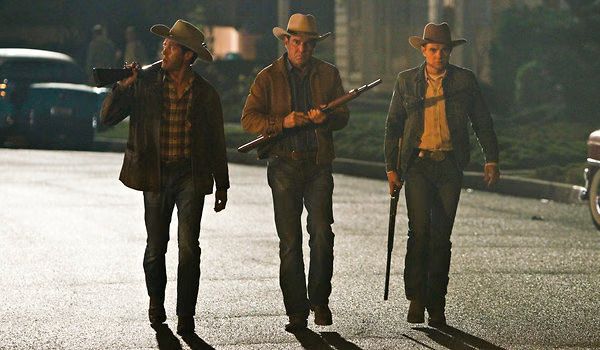
Vegas, the new series from TV writer Greg Walker and Goodfellas screenwriter Nicholas Pileggi, has a lot riding on its shoulders. It's been a while since CBS has had a hit this critically lauded heading into its premiere. You'd probably have to go back to the series premiere of The Good Wife to find a show with this kind of buzz. Naturally, the series, which follows the exploits of legendary Vegas lawman Ralph Lamb (Dennis Quaid), is right in CBS's procedural wheelhouse. It's a cop show, but, perhaps more importantly, it non-explicitly presents itself as a man's show, at least in the pilot. It's a story of men both rugged and ruthless, noble and ignoble alike, settling into a transitioning world. Whether they're prepared to meet said world on its own terms is a question the pilot seeks to address, as Lamb lets his fists do the talking, while Chicago mobster Victor Savino (Michael Chiklis) lets his wealth and influence open every door. It's an ambitious series, set in the 1960s, colored with all the opulence of the setting, and it's unique in its visual flair, boasting what is pretty much the best-looking new series on television, with an eye for period detail and a visual panache that recalls Goodfellas by way of High Noon. The series is promising from the start, and its pedigree bodes well for its future. Hell, the last time CBS debuted a procedural set in Las Vegas, it pretty much set the world ablaze.
Credit: CBS
The premiere opens with Lamb flipping out when Savino's plane deviates from its flight path and flies over his land, causing his herd of cattle to scatter. He deals with the air employees by beating each one of them senseless, and we're suddenly made aware exactly the kind of man we're dealing with: the kind of man Mayor Ted Bennett (Michael O'Neill) needs as his Sheriff. Bennett asks for Lamb's help in solving the murder of the governor's niece, a young woman named Samantha Mead. Lamb agrees under the condition that Bennett gets the planes to stop flying over his land. Perhaps more than the violent outburst at the air strip, this moment keys us into Lamb's character. He isn't interested in money, any more than he's interested in actually getting involved in the affairs of the transitioning world. He's a man marked by his dedication to the old ways, to hard work and privation, to a man settling his own affairs and keeping to his word. When Bennett says he'll maybe be able to work something out with regards to the flight path over his land, Lamb instructs him to drop the "maybe" if he wants a deal. For Lamb, a man is only as good as his word.
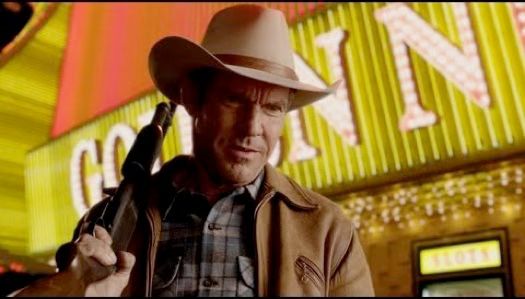
The case itself is fairly routine, with Lamb replacing the cold, clinical science of CSI with the door-to-door investigating style of classic Law & Order. He pieces out the particulars alongside his deputized younger brother, Jack (Jason O'Mara), and young son, Dixon (Taylor Handley). The son is the only person who doesn't seem immediately concerned with getting back to the ranch, commenting perhaps on the disconnect between the youths and opportunists geared towards Vegas's expansion, and the old guard, who'd prefer being left to their own devices on their private plot of land, free from reckless civilization encroaching upon their peace. The Brothers Lamb don't seem particularly interested in the business of policework, even though we're told Ralph was once an MP during the war. For these two, the investigation is merely a means to the end of not being bothered by airplanes. But, as A.D.A Katherine O'Connell (Carrie-Anne Moss) states, "That's a battle you're not going to win."
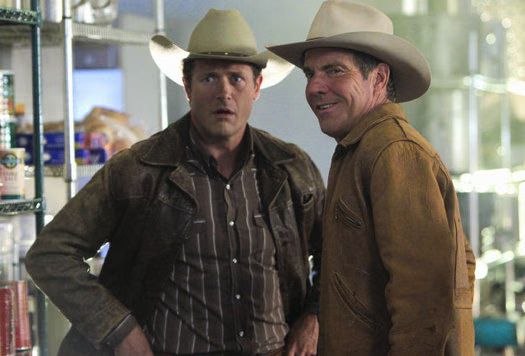
Quaid is an effective leading man all throughout this pilot, even if he doesn't have much chemistry with brother O'Mara. There's the hint of a spark with Moss (as assistant district attorney O'Connell, who was once neighbors with Lamb), though he seems to still carry a torch for his late wife beneath his gruff facade. At least it certainly felt that way. We're told his wife died, but his pain is more a projection of the performance, so perhaps Quaid deserves even more credit than he's getting. He probably should have been nominated for an Oscar for his performance in 2002's Far From Heaven, but that's neither here nor there. It's funny, actually, since the trailers for the show had me initially feeling that Quaid was tragically miscast, as I didn't feel he communicated the necessary amount of world-weariness the role necessitated. Having watched the premiere, I realize how erroneous that opinion turned out to be, since that isn't really the character Quaid is playing at all. Lamb isn't world weary, at least not yet. He's very much at home in his own world, a place to which he would gladly return, but for all this police work that's fallen into his lap. He doesn't want this. He just wants the simplicity of life on the ranch. This vice-ridden world is bad enough, but the encroachment of burgeoning civilization is an altogether separate source of frustration for him. It's fine work from the veteran Quaid.
Credit: CBS
Michael Chiklis also acquits himself well as mobster Savino. We don't get much of Savino this week, but in his few scenes he communicates equal parts likability and menace, a Tony Soprano for the 60s set. Beating on one of his associate's cronies for laying hands on an informant without his permission is one of the highlights of the premiere. He's the most exciting character on the show, and part of why the potential for the series is through the roof, since he's not tied down by the parameters of being a real life person (like Lamb), even if he is at least partially based upon real-life gangster Marcello Giuseppe Caifano. The cast is a strong element for the show, complementing the high production values and making use of the setting to really craft an immerse experience for the viewer, which is necessary to really enjoy period shows like this.
The murder investigation is pretty light stuff, with implications that the victim wasn't the doe-eyed innocent she appeared to be, but that's pretty rote for a cop procedural, especially if it's a case like this, which feels like it's been solved before it ever really started. Hopefully, the cases grow more complex in future episodes, particularly when they begin to intersect in a more substantial way with Savino's dealings in the Savoy. The show has already shown the potential for intrigue, and I'll be interested to see if the series can handle Machiavellian maneuvering as well as they can establishing a visually-arresting setting. The episode's set pieces, at least, are an interesting contrast to the standard narrative constructed around them.
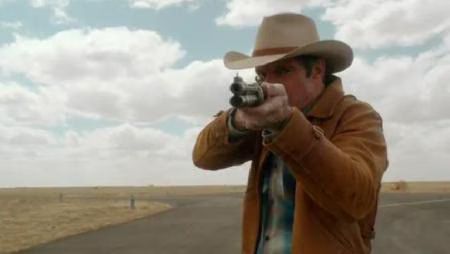
The climax, in which Lamb plays a game of chicken with a fleeing perp, staring down the barrel of a shotgun, blowing out both the man's tires at just the last minute, is laced with bravado. Moments like these are effective because they communicate character, such as Lamb's stonewall tenacity, without having to do the grunt work of spelling it out. Such moments also succeed in that, frankly, they're exciting. However, they aren't necessarily gems across the board. There's a scene in which a biker gang is corralled like cattle with nothing more than horses and shotguns. It's amusing, but feels contrived, if not entirely implausible in its gung-ho sensibility. Of course, the real Ralph Lamb is a figure of mythic proportion, having lived a life that'd would be sooner dismissed as fable than embraced as reality, so there's a certain suspension of disbelief that must be afforded here, whether scenes like these ever transpired in Lamb's eighteen years as Sheriff.
And, yes, he is named Sheriff, by episode's end. The premiere doesn't try to hide its intentions from the get-go. Lamb and the Mayor pay lip service to the idea of this investigation being a one-time job, but we all know that he's in it for the long haul, whether he likes it or not. It's a Gotham City scenario. Lamb is the hero Vegas deserves, but not the one it needs right now. Well, until it does.