Vegas - Season 1 Episode 5 - Recap and Review - Solid Citizens
Vegas is still one of the TV season's best new offerings, but with each week, it's felt as though it's been losing much of the nuance that made it such an outstanding series in its early goings. Thankfully, "Solid Citizens" rectifies many of my issues with the series so far: mostly that much of the series consists of fine episodes that don't seem to aspire to much more than simply being just that; a disparity in the depth of characterization between Savino (Michael Chiklis), who acquires layers to his characterization with each week, and Sheriff Lamb (Dennis Quaid), who remains relatively static from one episode to the next (excepting last week's glimpse into Lamb's lingering pathos over the loss of his wife and his burgeoning irrelevance in Las Vegas' more corrupt, commercial age). For the clash between these characters to work, they need to come into the conflict as equals, as far as their level of characterization is concerned. "Solid Citizens" does the work of fleshing out both of our leads in more substantial fashion. There's a barely restrained ambition in this series to be the kind of show that gives cable TV a run for its money, and episode like "Solid Citizens" serve that ambition well.
Credit: Robert Voets/CBS
This week's case involves the kidnapping of the young son gaming commissioner Milton Larson (Greg Grunberg). In an act less motivated by evidence and instead by Ralph's own prejudices, the Sheriff arrives at Savino's doorstep, demanding to know which gangsters might have decided that a little boy would make for a good bargaining chip. It's not hard to see how he'd expect Savino or one of his familiars, given that Savino could theoretically fast-track a gaming license to the dying Tumbleweed Club which Savino is interested in co-owning and renovating. Savino, indignant at Ralph's inferences, tells the Sheriff that no gangster would opt for a kidnapping when a sack of money would do just as well, and Lamb takes the blow on the chin and starts from scratch. Can't say Savino isn't a thinking man's gangster.
The perps eventually call and set up a ransoming, and Ralph arrives at the drop-off point under the guise of the boy's uncle. Ralph gets a great, unexpectedly comic line when he tells the perpetrator, in response to his assertion that Ralph sounded younger on the phone, "You sounded prettier." When the perp changes the terms of the deal once he's gotten his ransom money, a shootout ensues, with brother Jack (Jason O'Mara) providing some well-timed backup. It's these sorts of moments in the case that feel somewhat contrived, filled in by the need to have an action setpiece. These choices make it feel as if the show doesn't have enough faith in its case or its characters to hold our attention. More rewarding than the shootout was the scene in which Ralph basically has to keep the peace between the perpetrator and Mr. Larson, which shows the resiliency of Sheriff Lamb and illustrates just why he's the perfect man for the position. And if that scene didn't exist, we'd still have Mayor Bennett (Michael O'Neill) to remind us that Ralph was chosen because he's the kind of man with no tolerance for injustice. He's the kind of man who can't sleep so long as there are people out there, doing wrong in his town. It's an essential facet of Lamb's character, and we see that not only does this blunt assessment affect Ralph throughout the episode, but the case comes to affect him as well. Seeing the kind of damage that potentially losing a child can do to a man, Ralph relegates his son, Dixon (Taylor Handley) to desk duty to keep him out of the line of fire, even though, several weeks back, Dixon proved that he could hold his own in a high-risk situation, saving his father's life from a would-be gunman. The decision sticks in Dixon's craw, but it doesn't seem like there's anything to be done about it when Ralph Lamb is your father. The choice to paint Ralph as a father first, and a Sheriff second, lends him a universal quality that makes him instantly more relatable, and deepens his character.

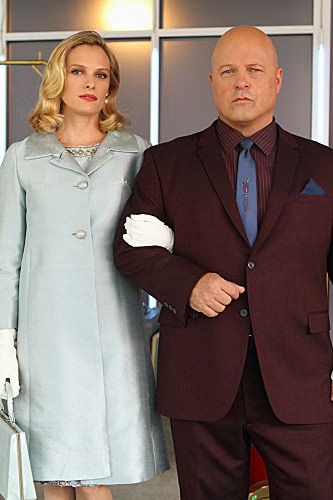
Also intriguing is the introduction of Savino's wife, Laura (Vinessa Shaw), who doesn't want to get involved in the family business, and would prefer not to know what Savino does altogether. Savino, however, intends for Laura to move to Vegas with him. Much like any gangster in fiction, it's Savino's desire to go straight, to be a legit businessman, and he feels ownership of The Tumbleweed Club is his ticket to legitimacy. This enriches Savino's characterization by making him more than just a power-hungry thug in a tailored suit. He wants legitimacy and the status that it affords, both for himself and for his wife. I'm definitely on-board with this, and with his overall arc, which has seen new complications in the form of a cold-blooded mob hitman from Milwaukee named Mr. Jones (Damon Herriman). Jones doesn't say much, but he's a terrifying figure both through Herriman's look and his icy portrayal, as Jones is searching for the man Savino had killed last week, and tortures his way through witnesses to get leads on the case. When Jones comes to Savino for answers, the mobster bluffs that the man is still alive and is simply in hiding, a gambit that relies upon the reconstruction of the deceased's car in order to fool Jones. It would appear that Mr. Jones is out of Savino's hair (which is incredible, since he's bald) for now, but expect him to return sooner rather than later, since Savino really has all the luck in the world, clearly. At the very least, his conflict with Ralph provides enough tense moments to make one wonder just when they're going to come to blows already, although the war of words is infinitely more interesting.
"Solid Citizens" pulls off the hat trick of an interesting case, deepening characterizations, and promising developments. In a lesser show, Savino's attempts to ingratiate himself to a Mormon banker in order to take over The Tumbleweed Club would feel immaterial to the overall narrative the episode is trying to present, particularly one with as much going on as this week's installment. But there's a larger game being played in Vegas, in which everyone is gambling in some form or another, whether it's Lamb's power plays with perps, or Savino's double-dealings with mob associates. Vegas is rich with conflict from week-to-week, and it's that kind of energy that's going to keep the show feeling alive with possibility.
