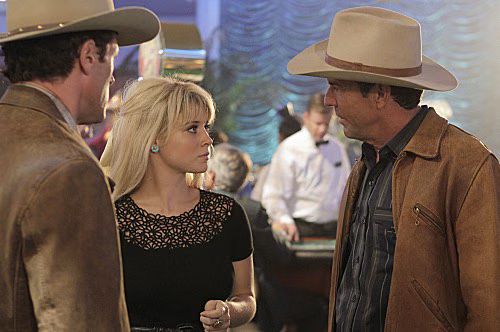
Vegas - Season 1 Episode 4 - Recap and Review - (Il)Legitimate
Vegas goes all-in on developing its serialized aspects. The tug-of-war between Vincent Savino (Michael Chiklis) and any number of mob outfits is one of the more compelling threads the series follows from week-to-week, and "(Il)Legitimate" feels like a more substantial step towards crafting a show that's less procedural, and more an incisive look into the shifting mores of Las Vegas, and the moral war between those who seek to run it. Of particular interest is the gap between the old guard, represented by Sheriff Ralph Lamb (Dennis Quaid), the noble westerner who refuses to allow a century oak to be cut down simply so a well can be built, and Savino, who spends the episode trying to expand his hold on Vegas territory, running afoul of mobsters who don't take too kindly to his business practices. The two cases intersect more substantially this week than in weeks past, with the narrative of the anti-union gangsters gunning for Savino dovetailing nicely into Ralph's investigation into the murder of an African-American maid looking to unionize fellow hotel staff. It's a solid week of focused storytelling, with a whiz-bang bit of filmmaking to close out the episode. This bodes well for the rest of the show's first season, which was just picked up by CBS for a full season order.
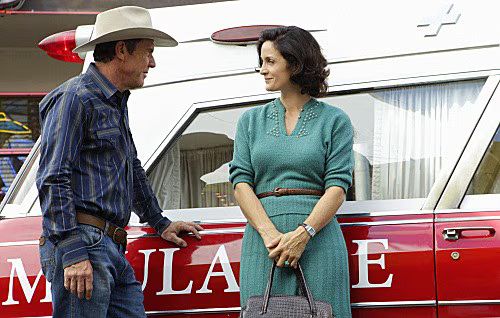
The murder investigated by Ralph is initially vague in terms of the manner of death, with the lawmen debating whether it was an accident or homicide. The maid in question was ruffling a lot of feathers with her unionizing rhetoric, from the chief shop steward (Wade Williams) to the wealthy white man (Christopher Cousins) who is later revealed to be her father. Vegas is a series that, aesthetically, pays due diligence to recreating period details. However, the attitude of the period is often lacking, if not altogether absent. "(Il)Legitimate" decides to put a scope on the race designations of 1960, with the disparity in wages and respect for the colored workers, along with the fear and secrecy of an affluent white man having sired a colored daughter who wanted nothing more than to have a real father in her life. In this respect, the episode does a good job of setting up this racial divide as the motivating factor in the woman's murder, and while race has something to do with it, it's not really the motive itself. In an eleventh hour reveal, we learn it was one of the woman's co-workers, angry and jealous at the fact that the woman had been running her mouth about change, and making sacrifices, while having a wealthy white father to pay her way the entire time. It's hardly virgin territory, but it fits, even if the reveal comes across as contrived in how drastic the culprit's transformation into a villain happens to be. That said, I did like that the culprit was pretty much right in front of us the entire time, lingering in the background. It encourages more attentive viewership from its audience, and shies away from the more standard procedural trope of the culprit being the first person the detectives talk to in any investigation.
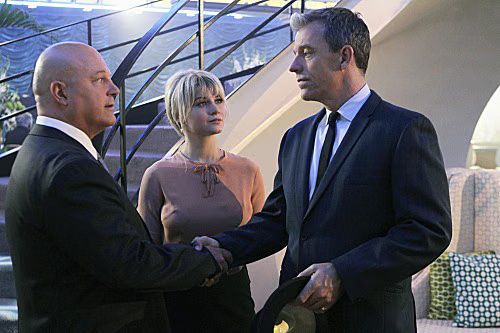
Meanwhile, Savino is walking on eggshells, as his intention to become part-owner of the Tumbleweed Club brings him under literal fire from the Milwaukee mob. Our Vincent is a pretty savvy guy, and resourceful enough to make his way past any assassination attempts, and you would think mobsters would know better than to go after the guy directly. The montage towards the end of the episode, set to Dean Martin's "Ain't That A Kick In the Head," is like a suave takeoff of the baptism scene at the end of The Godfather, with Vincent's enemies brought to heel for daring to rise against him. Vincent's methods provide a fitting contrast to Ralph's by-the-book approach, even though both men's approaches are by-the-book - they're simply different books. It's no surprise then that the montage leads us into Ralph's contemplative moment, staring at the tree out in his yard, and having an ephemeral memory of his late wife. The tree is a symbol of Ralph's past, and of his relevance in the changing world. While neither his brother, Jack (Jason O' Mara), nor his son, Dixon (Taylor Handley), seem to understand the significance of nature's seniority, Ralph isn't nearly so modern. So of course he'll cling to whatever semblance of normalcy remains to him, that lingering shred of the past that's still clinging on every bit as hard as he is himself, a symbol of his own inertia. It's the kind of introspection Ralph will have to do on his own, since Dixon leans heavily toward the modern, and Jack is apparently busy throwing himself at Mia Rizzo (Sarah Jones) these days (and really, who can blame him?). Maybe his role as Sheriff will bring him into closer contact with his own, true sense of self.
"(Il)Legitimate" is a very good episode of Vegas, and even though there's still a lot the show could be doing better, such as tying its procedural aspects into the period narrative it seems intent on telling, the show is pretty engaging as it is.