Vegas - Season 1 Episode 2 - Recap and Review - Money Plays
On its face, Vegas is simply an engaging, well-written police procedural, glossy with the trappings of first-rate filmmaking and a setting that is as ritzy as they come. But Vegas aspires to be about a more than all that. "Money Plays" is as much about a city in transition as it is about the larger-than-life lawman Ralph Lamb (Dennis Quaid) and his deputized relatives, brother Jack (Jason O'Mara) and adult son Dixon (Taylor Handley). It's easy to see the extent to which Ralph is resistant to change, the creeping emergence of the Las Vegas we know now, a world that seems to ooze sleaze in its better moments, and outright corruption in its worst. There's also a sense of the world falling to the demands of commerce, as District Attorney Rich Reynolds (Michael Reilly Burke) suggests that they keep news under wraps concerning the exploits of a pair of brothers responsible for robbing casino employees at gunpoint, for fear that the story could hurt tourism. Of course, Reynolds's motivations are twofold, as he's shown to be in the pocket of mobster Vincent Savino (Michael Chiklis). Las Vegas has already gone to the wolves.
"Money Plays" follows not long after the events of the premiere, in which Bob Parrin was arrested for the murder of Samantha Meade, the governor's niece, who'd stumbled onto the Savoy manager's book-cooking criminal enterprising. As a result of his actions, he's looking at a one-way trip to the gas chamber; luckily for Parrin, however, he has a wealth of information on the criminal activities that are the foundation of the Savoy's operation. With his testimony, Parrin could essentially give up the entire Chicago mob. Savino can't allow this to happen, and sets up a series of schemes to make the problem go away, but these are thwarted by the presence of Federal prosecutors, who are claiming jurisdiction of the case because Meade's body was found on federal land. Savino's schemes are as amusing as they are circuitous, with the first being an elaborate ploy to get one of his own men arrested, by assaulting Dixon over a staged traffic accident, so that he could finish off Parrin while in lock-up. This fails due to Dixon's sudden appearance, though Savino's quick-witted plan B succeeds. He busts open a fire hydrant, which creates a detour that leads the Federal transport directly into the path of a bomb, which incinerates the car, and Perrin along with it. Savino might not have even gotten the idea in the first place without the similarly ambitious, back-handed scheming of his new counting room manager, Mia Rizzo (Sarah Jones).

The daughter of a mob boss, Mia is beautiful and remarkably savvy, not only discovering new profit revenues for the casino, but doing an end-run around Savino by getting her father to approve the new venture. Savino discovers the truth and confronts Mia, who tells him that she had to go behind his back - when you're left with no other options, you need to create options yourself. This gives Savino the idea, and the impetus, to find his own solution to the Perrin problem when all other avenues fail him, and it's interesting, in many respects, to see a mob bigwig doing the grunt work. Mia is the first character other than Lamb to stand up to the powerful Savino in any substantial way, thus far, and she provides a nice contrast to the subdued nature of A.D.A. Katherine O'Connell (Carrie-Anne Moss), who is the antithesis to Jones's clever femme fatale.

However, all these backroom dealings are on the periphery of our case of the week, which finds well-loved craps dealer Wes Sutcliffe bound and murdered, with his terrified girlfriend locked in a trunk in their garage. The case is interesting not so much in its particulars, but in how it develops the dynamic between the Lambs in this new venture as enforcers of the law, a business as family-run as their ranch. When the case implicates a pair of brothers who purchased a client list from a safemaker, the Lambs head out to the site of the next expected robbery. Ralph orders Dixon to wait outside, putting down Dixon's assertion that he's a good shot with "These are cold-blooded killers, not tin cans on a fence." It quickly becomes apparent that a robbery is under way, and when the robbers appear, guns start blazing, and it's Dixon who ends up saving the day, putting a bullet in the back of his father's would-be killer. It's a startling setpiece that ratchets up the tension incrementally, and the aftermath, in which Ralph and Dixon share a wordless moment of understanding, is equally well-presented. In fact, the majority of "Money Plays" is sumptuously shot, using the camera to starkly illustrate the contrasts between the decay of the old Vegas amidst the bombast of the new. The use of color is pretty remarkable, and Vegas is quickly proving to be a show that, if not substantively alluring, is just plain pretty to look at each week.
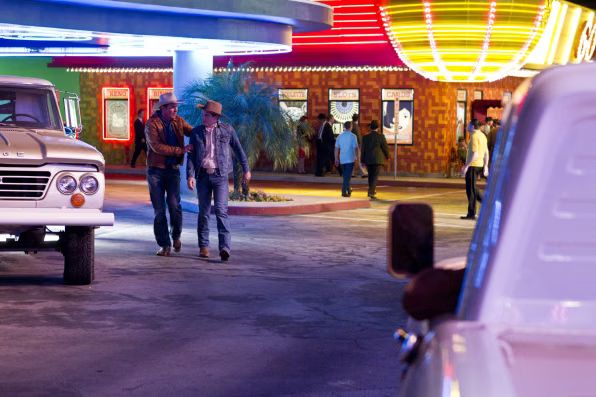
In addition to what it tells us about the Lambs, the case this week also comments upon the aforementioned separation between the two schools of thought on the forward creep of change in Las Vegas. The perp, a blue collar worker named Ted Ermin, confesses to killing the craps dealer primarily out of jealousy, having been the ex-boyfriend of Sutcliffe's girl. But it goes deeper than that. He resented her leaving him for the casinos, and hated that a "card-flipper" would be the one to finally help her reclaim her family's ranch, which she'd lost due to her diminished finances. Ermin considered himself the "good cowboy," and misses the days in which the good cowboy always got the girl. But those days are passed because of the emergence of a world that values commerce about...well, values. It's twisted logic, and creates a moral grey area for our protagonist, Ralph, as we know from last week that he's not necessarily happy about what Vegas is becoming either. But while he agrees with Ermin's cowboy analogy, he adds that it doesn't give Ermin the right to go about killing people. Perhaps unsettled by his having identified with a killer's reasoning, it's less surprising that Ralph eventually admits the Sutcliffe's girlfriend, after getting her the title to her ranch back, that there's nothing anyone can do to stop the "neon wave crashing down on the other side of the ridge" (as the girlfriend puts it). If he hasn't entirely accepted his role as Sheriff, Ralph has at least accepted his inability to stop the forward march of self-interest.
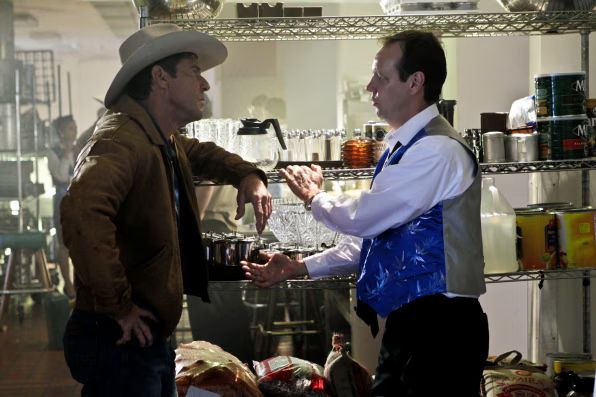
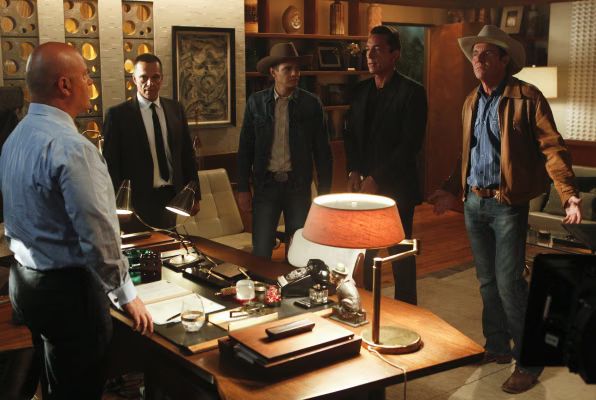
Except that Ralph kind of is settling into his role as Sheriff, quite nicely, in fact. Dennis Quaid plays Ralph as a man for all seasons, a resourceful, relentless bastion of good. He refuses to accept comped meals at the diner, insisting upon paying his way; not moments later, he foils a jewelry store robbery by commandeering a janitor's broom and knee-capping the assailant. It's incredibly hard not to be enamored of Ralph, and really, viewers like their heroes to be capable and efficient anyhow. By that score, Ralph Lamb is a triumph of a character, probably as much so as he was in life. Apparently, some of the exploits of the factual Lamb are worth investigating, though whether they involved a mobster like Savino eludes me. As Savino drives by while Ralph empties the perp's shotgun, they lock eyes. It's the first in a series of the episode's escalations in the Savino-Lamb rivalry, extending to a tense standoff in which Ralph places the old Sheriff's crooked casino bribes back in Savino's upturned hat (his hat as much a symbol of this new Las Vegas as Lamb's Stetson is a symbol of the old guard). After returning home at the end of the episode, Ralph discovers Savino's: those same casino chips arrayed in stacks on his desk, a warning to watch his back. If it wasn't on before, it's on now.
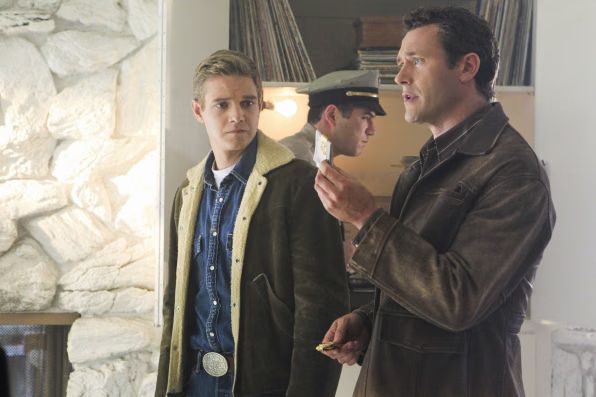
"Money Plays" does nothing to sully the momentum of the premiere, and even improves upon many of the elements that hindered last week's episode (Dixon doesn't seem quite like such a cartoon, and Jason O'Mara is developing some good brotherly chemistry with Dennis Quaid). The show seems interested in telling far-reaching arcs that look to last the season, as opposed to telling self-contained procedural storylines that are finished by episode's end. We'll still get those types of stories, to be sure, but they seem to be part of a larger whole, a fabric the show is weaving for its setting and its characters - people who are every bit in transition as their town. And some may take the change better than others.