The Walking Dead - Season 3 Episode 13 - Recap Video and Review - Arrow On The Doorpost
Recap video and review of The Walking Dead - Season 3 Episode 13 - Arrow On The Doorpost:
The Walking Dead is better than almost any show on television when it comes to setting a tone of imminent dread. This second half of season three excels at building the tension of the upcoming war between Rick's prison group and The Governor's Woodbury. There are calculating, intelligent parties in this conflict. It's not like last season at Hershel's farm, where the walkers were the primary threat. Here, it's their fellow man. The Governor (David Morrissey) is a tactician who makes a play at fair-minded governance, implying the possibility of a non-violent resolution to the conflict. But he wants war just as badly as, say, Merle (Michael Rooker). The Governor isn't really about peace, he's about domination. I found that I became much more invested in his character, as a villain, once that facet of his personality calcified. He's a terrible person, without question, but it makes him feel more three-dimensional to not only see that his conflict with Rick (Andrew Lincoln) is personal, but to get some semblance of why. War is just an extension of the pissing contest between the two heads of state in The Walking Dead universe, and though Rick is actually taking a peaceful resolution into consideration, "Arrow On The Doorpost" shows that, for once, discretion might not be the better part of valor.
Credit: AMC
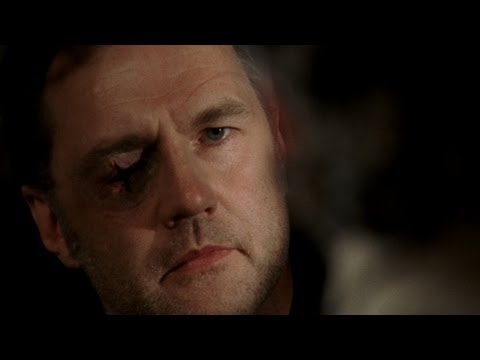
"Arrow On The Doorpost" is all about building tension for the upcoming war, and on that score, it's tremendous. Much of that tension follows a war council between Rick and The Governor in a neutral territory, a barn that rests between the prison and Woodbury. They discuss possible terms for a settlement, and the series of scenes the men share with one another do the business of communicating just how deep their rivalry has become, without either man necessarily raising his voice or being overtly confrontational. You have The Governor asking the inquisitive Rick if he's a cop or a lawyer, with Rick passive-aggressively responding that at least he doesn't pretend to be a Governor. Then you have The Governor teasing Rick with the knowledge that his baby girl might not actually be his (intel gleaned from Andrea, because Andrea is the worst). He then recounts the tragic loss of his wife prior to the outbreak, in an accident that was "nobody's fault." It's my favorite scene of the episode if only for the pained nonchalance (an oxymoron, if ever there was one) in Morrissey's performance: you can see how much his wife's death still affects him, but it's also noticeable just how far he's come from that point of grief. Yes, it still weighs on him, but that grief has simply become part of the fabric of this Alpha male personality, as if he's saying, Well, I've been through some s***. I've seen loss before all this started. So I know better than you. Ultimately, The Governor challenges Rick to save his people by giving him what he wants: Michonne (Danai Gurira). He wants the person who took his eye -- a literal eye-for-an-eye situation. If Ricks hands over Michonne, this all goes away. He gives Rick two days to think it over.
Credit: AMC
Of course, by episode's end, we learn that The Governor has no intention of honoring the bargain, telling Milton (Dallas Roberts) that he plans to kill whomever escorts Michonne to Woodbury. Milton believes this is slaughter, but The Governor is past the point of caring about keeping his word. As he says, "We'd have to take out Rick sooner or later." There's only room enough in this world for one of them, to beat a cliche into the ground. That said, I did feel it was kind of a shame to learn of The Governor's double-crossing intentions, as Morrissey's performance of The Governor allowed for enough ambiguity for us to suspect that he was possibly telling the truth: that he would keep his word, so long as he had Michonne. Knowing that The Governor is lying takes away some of the drama of the decision Rick has to make. He tells the group, upon returning to the prison, that The Governor offered him no turns, and that they all must prepare for war.
However, he later tells Hershel (Scott Wilson) the truth. Hershel wants to know why he lied to the rest of the group, and Rick rationalizes that he wants everyone to be scared about possibly having to fight, so that they'll be more accepting when he tells them there's a way out, through handing over Michonne. Hershel tries to sell Rick on how Michonne is now one of them, that she's earned her place among them. This characterization of Michonne as someone firmly on the inside of Rick's group is a development that piggybacks off of last week's outstanding episode, where we got the sense that Michonne had finally started to belong with Rick's party, and that they, in turn, had begun to accept her. Hershel wants to know why Rick would tell him all this if his mind's already made up, to which Rick responds that he had been hoping that Hershel would be able to talk him out of it. Rick is clearly conflicted over doing what's in the best interest of the group vs. the principle of not sacrificing one of their own simply to satisfy The Governor. He's between a rock and a hard place, and not even Hershel can be sure what he'd do, as he can't bring himself to say that he would let Maggie or Beth die in Michonne's place. Rick looks out past the prison courtyard towards Woodbury as he debates his decision, and one would hope he hasn't gone so crazy that he'd take The Governor at his word. But then, The Governor has that soothing Southern drawl that could probably talk a person into any number of terrible ideas.
Credit: AMC
What happens during the meeting between Rick and The Governor is nearly as interesting, though these scenes are small and intended only to help flesh out the conflict at hand. Milton has a talk with Hershel and gets inquisitive about his leg, showing genuine interest when Hershel reveals that his group was able to stop the infection from a walker bite by amputating immediately. Milton asks to see the leg, at which point Hershel jokes, "I'm not showing you my leg. I hardly know you! At least buy me a drink first." It's a warm moment that illustrates the benign elements of the conflict, as Milton and Hershel are the two men in this whole thing who are least likely to actually harm anyone, though for different reasons. Meanwhile, Andrea (Laurie Holden) hunts walkers in the surrounding area with Daryl (Norman Reedus) and The Governor's right-hand man Martinez (Jose Pablo Cantillo), with whom the younger Dixon brother gets into a game of one-upmanship. Andrea is certainly a capable walker exterminator, but she's dueling with her conscience, as she doesn't want to be with The Governor anymore, leading Hershel to offer her a spot back with Rick's group, stating "You're family. You belong with us," in one of the more poignant moments of the episode. I find I love Hershel quite a bit this season.
Credit: AMC
Lastly, there's a brewing conflict at the prison, as Merle wants to mobilize against The Governor right this moment, rationalizing that his little brother is out there. However, Glenn is in charge and refuses him, going so far as to wrestle Merle down when he tries to leave (with help from the Greene sisters, as Maggie gets Merle in a chokehold while Beth fires a warning shot to break up the fight). The rush of the confrontation results in Glenn and Maggie having sex while they're supposed to be on watch, which had me worrying that someone would get killed, since the show has done an excellent job of fostering the "anyone can die at any time" tension that's been lacking in past seasons. Though, ultimately, no one is injured or killed, it added an extra oomph of tension to an episode that was already rife with potential for explosive conflict.
"Arrow On The Doorpost" can come across like a placeholder episode in the sense that it's used as a bridge to the larger conflicts of the remaining three episodes this season. But it does such a great job building a horrifically tense atmosphere that I can't fault the episode for taking its time, developing the story that the rest of the season will tell in increasingly urgent fashion.