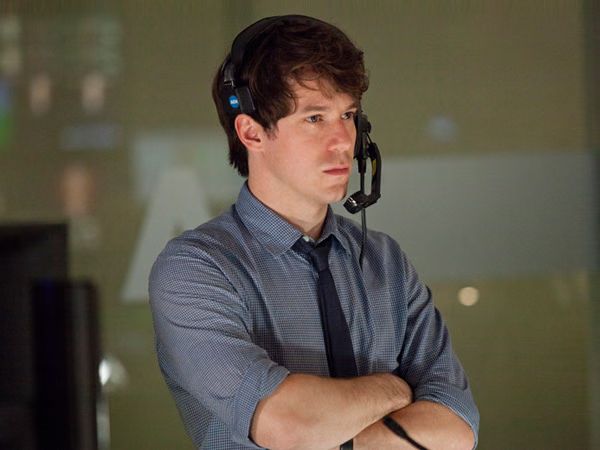
The Newsroom - Series Premiere - We Just Decided To
Aaron Sorkin is no stranger to TV. The creative mastermind behind megahit The West Wing, critical cult classic Sports Night, and high-profile flop Studio 60 on the Sunset Strip has had an on-and-off relationship with the televised medium. The latter show, in particular, was a notably embarrassing disaster, derided as a preachy, self-important mess that indulged the worst excesses of Sorkin's writing by the time its 22-episode run came to an end. Worse, NBC had put a considerable amount of stock in the success of the Matthew Perry-fronted show, owing to Sorkin's renown and the high expectations behind the premise of the series, which followed the goings-on behind the scenes of a fictional “Saturday Night Live”-esque sketch comedy program. Sorkin took a much-needed sabbatical from television and turned his eye toward film, where his writing talents have recently found greater purchase, earning him an Oscar for The Social Network, with a follow-up nomination for the script to Moneyball. So why return to TV? The short answer is because you can't shoehorn your own ideology into a screenplay adapted from preexisting material. But even taking this into consideration, The Newsroom is a lot closer to compelling television than Studio 60.
Jeff Daniels plays Will McAvoy, a cable TV news anchor who's built a career on remaining non-partisan, attempting to remain palatable to as many different demographics as possible, while simultaneously being insufferable to his producers and staff behind the scenes. McAvoy's insistence upon playing it dispassionately down-the-middle is thrown into disarray at a university forum alongside a pair of cable news colleagues, in which a college sophomore asks each of the panelists to explain why they feel America is the greatest country in the world. Fed up with the moderator's prodding for a more involved answer, McAvoy pulls a Howard Beale, and details the extent to which America is no longer the greatest country in the world; quite the opposite, as McAvoy likens America to an embarrassed shell of its former self, a chest-beating bully with pretensions towards serving as world police.
The meltdown finds McAvoy on hiatus. Upon his return, his show, News Night, undergoes a series of structural changes: Will learns his executive producer Don Keefer (played by Thomas Sadoski) is leaving for a rival program, taking much of the staff with him, while Will's boss Charlie Skinner (a Walter Cronkite/Mike Wallace-type battleaxe of old school journalism, played by the redoubtable Sam Waterston) has hired an ex-colleague of Will's with whom he shares an unspecified personal history.
This latter dynamic, between Daniels and Emily Mortimer (who plays Will's ex-colleague Mackenzie MacHale), is among the show's strongest, as MacHale serves as the conscience of the acerbic McAvoy. Will treats his colleagues dismissively, yet MacHale is forced to rein him in, humbling him in front of the staff, as in one particularly strong sequence where, moments before McAvoy goes to air, MacHale demands tacit acknowledgement that she owns Will for one hour a day, five days a week. Even though we know there are elements to Will worth respecting, it's still great to see him knocked down a peg. And though we can likely infer what the unspecified personal history between them is, it's still a rich relationship with potential to evolve.

Of course, as in any Sorkin show, it's no big revelation to say that the cast is among the strongest elements. The indefatigable Alison Pill plays Maggie Jordan, an intern promoted to associate producer of News Night, all despite Will being unable to remember her name, if he ever knew it to begin with. Complicating matters for Maggie is her relationship with Don Keefer, along with the introduction of Jim Harper (played by John Gallagher, Jr.), a whip-smart producer who turns down a job offer from a rival network to follow friend/colleague Mackenzie MacHale to Atlantis Cable News (ACN). Rounding out the cast is Slumdog Millionaire's Dev Patel as Neal Sampat, who maintains the blog Will didn't even know he had, while simultaneously scanning the Internet for relevant news.
It's a strong ensemble, and though some bits are interesting enough, such as the conversation in Will's office in which Mackenzie likens herself to Don Quixote and Will to his horse, others bear lower-hanging fruit, such as the business of Maggie and Don's “How serious are we, exactly?” relationship. It's when news is broken and the threadbare staff has to rally together to verify the story's veracity before going on the air with it that the show really springs to life. Since the show is set in 2010, the pilot is able to take certain liberties with the news. When the story breaks of an oil rig exploding off the Gulf of Mexico, the Deepwater Horizon scandal that made “BP” and “Halliburton” household conversation topics, the show lives up to the promise of its premise. There's considerable drama in Jim trying to get through to the disbelieving Don that Halliburton doesn't know how to cap the oil spill, set against Don's reluctance to run with the story for fear that, if they're wrong, the resulting defamation lawsuit will bury the network. There's a frantic kind of music to the way these people talk when going straight to the horse's mouth, demanding statements from Halliburton, verifying existing statements, and gathering specific details. It would be very easy to get lost in these moments, but the direction of Greg Mattola (“Superbad,” “Adventureland,” and several episodes of “Arrested Development”) helps to keep Sorkin's all-over-the-place script, with its mile-a-minute dialogue, in check. It's visceral television, with the entire staff flying by the seat of their pants to get this story verified, and then get it on the air first, with Will going to air without a teleprompter and just winging it. It's alive in the same way The Social Network was alive. You get the feeling that something real is happening here, even if the mechanism by which we get to that reality (Atlantis Cable News) is entirely fictional.
That said, there are many of the Sorkin tropes still at play here. The sanctimonious soapboxing might turn off a lot of the viewers who might otherwise have given this show a chance, since McAvoy's ravings can be taken to represent Sorkin's own political leanings, if you believe that many of Sorkin's original scripts are extensions of his own ideals. McAvoy's speech in which he decries the current generations as the “Worst. Generation. Ever.,” has the potential to insult as much as it interests. Couching the decline of the United States, as a nation, in the rhetoric of generational conflict reads as a mistake to me. Hell, my graduate thesis was actually on the rhetoric of American Exceptionalism (because I'm trying to win at Hipster Bingo, you see, since I already drink Pabst Blue Ribbon and listen to Wilco), and I don't think the need to trumpet America as being greater than it is has anything to do with the generation doing the boasting. Yet McAvoy, and Sorkin by proxy, seems to deride the current generation for failures that have been inherited. It's easy enough to put an entire generation under the microscope for giving the Kardashians their fame, but hardly enough time has passed for the intellectuals of that same generation to acquit themselves through action. In McAvoy, Sorkin has created a character whose ideology is too liberal for conservatives to embrace, yet entirely too obstinate for liberals to latch onto. This show will likely rise or fall by how Will McAvoy changes and grows, if he should change or grow at all. Daniels is a remarkably capable actor, and he has wonderful interplay with the rest of the cast, but I don't know that there are many actors that can overcome a character with this much insufferable sanctimony. And the “You're hearing something revelatory” piano cues during the big speeches don't help.
However, it's only been one episode, and it was a damn fine one, at that. Aaron Sorkin is back on TV, in a big way, and if the focus remains tight on the ins-and-outs of operating within cable network news, this could really be a show to remember, and not as a footnote.