The Killing - Season 2 Finale - Recap and Review - What I Know
After two seasons of varying quality, the Rosie Larsen case finally comes to a close, as the killer is finally revealed.
*Drum roll*
Rosie Larsen's killer is...
Jamie Wright, campaign manager to Darren Richmond.
At least, that's what the exhilarating first ten minutes would have us believe. However, while Jamie did beat Rosie and stuff her into the trunk of the Richmond campaign car, it was ultimately Rosie's aunt Terry, the lover of married Seattle entrepreneur Michael Ames, who put the car in drive, sending Rosie, still alive, into the lake.
It is very likely that this will prove to be the show's series finale, given the downturn in ratings since the premiere, and though the show debuted last year to raves, the critical praise dwindled as the show became a morass of red herrings, wheel-spinning, and vague, one-dimensional characterizations. The critical backlash against the show culminated in a season finale that repelled viewers in droves. Season two has brought the show back to an average critical consensus, though I would argue the season has been above-average, owing to a more purposeful, narrowed focus on the Rosie Larsen investigation. Gone were the investigative dead-ends like Bennett Ahmed and Tom Drexler, along with Mitch Larsen's dead-eyed non-contributions (at least for the majority of the season). This was in service of finally portraying Linden (Mireille Enos) and Holder (Emmy hopeful Joel Kinnaman) as competent police detectives, following evidence as opposed to simply making leaps of logic at the first insinuation. Season two of The Killing was a show whose narrative was actually going somewhere, with episodes serving the direct purpose of getting us there, along with characterizations that, while not always nuanced, helped us to better understand these characters' motivations. It felt as though the show finally remembered it was about getting to the bottom of who Rosie was and why she was killed, and went out of its way to satisfy that narrative conceit. If this is the series finale, then showrunner Veena Sud made certain the show went out on its strongest hour.
Mirroring the show's pilot, the episode begins with a flashback. Whereas the pilot began with Rosie's murder, this begins with the start of Rosie's last day. It's incredibly jarring to finally see Rosie in the flesh, and not simply through a security camera or super 8 stock, or even in the shadows of the woods in which she was being chased in the series pilot. In these opening minutes, we see just how typical a teenager Rosie really was, from bickering with her mother, to sharing a personal greeting with her hip, younger Aunt Terry. She even plays with her little brothers and promises to go camping with them, in a sweet little moment that shows just how much the boys loved their big sister. As Rosie leaves the house, she shares one last look with Stan, who is busy on the phone. The one person who, arguably, has taken Rosie's death and its accompanying fallout the hardest is the one person who doesn't get to share even the slightest moment with her on the day she dies. This brief flashback sequence is exactly the narrative technique this show should have been utilizing since day one, since it helps us to know this girl whose murder about which we're being asked to care. It establishes her closeness with her brothers and her aunt, the moody relationship she has with her mother, and the gradually distant relationship she shares with her father, Stan.Rosie turns and leaves, meaning to leave Seattle behind for good, not knowing just how permanent her departure would turn out to be.
Seeing this Rosie, and not the blank, mysterious girl with whom we've come to associate, immediately makes her death feel like a tragedy in a way it didn't before. Not that the murder of a teenager girl isn't a tragedy in and of itself, but we really had no notion of who exactly this girl was until tonight, with the opening flashback and the completed super 8 film at the end, which really served as a gut-punch that exacerbated a family's grief while also aiding their closure. But more on that later.
The first ten minutes are incredibly tense, with Linden and Holder following up on the security cam footage implicating Jamie last week. Gwen Eaton, Richmond's campaign aide/lover and Jamie's colleague, rightfully loses her mind when the detectives come to her with what they know. As Gwen makes frantic phone calls to just about everyone she knows in an effort to track down Richmond, Jamie gives Richmond his big parlor speech about how killing Rosie was an accident, that she wasn't supposed to be there. Indeed, Rosie was simply in the wrong place at the wrong time, having come up to the 10th floor of the Wapi Eagle Casino to have one last look at Seattle before following through on her plan to leave town and see the world. While there, she accidentally overhears Jamie, Wapi Eagle Casino chief Nicole Jackson, and Michael Ames discussing a plot to sabotage Richmond's waterfront development project in order to kickstart an Ames-owned company.
Overhearing the conspiracy proved to be enough to get Rosie killed. Jamie bludgeoned her with a flashlight and stuffed her in the trunk of a Richmond campaign car in order to keep the scandal from getting out and sinking Richmond's campaign. It's the classic "I did this for you!" justification, going much deeper when Jamie accuses Richmond of basically being a massive phoney, who let his wife die and cheated on Gwen with prostitutes. Linden, Holder, and Gwen get there just in time to find Jamie brandishing Richmond's gun, leaving it to Holder to end the standoff with a well-placed bullet. The episode could have ended right here and still have counted as a satisfying finale, closing the case and tying up the loose ends in one fell swoop. But on AMC, things can never be that simple.
When Linden and Holder come to the Larsen household to give them the news that they've solved the case, they find only Terry, standing beside a car with a busted taillight, much like the mysterious vehicle that picked up Michael Ames from the site of Rosie's murder on the night of her death. Enter the final twist: As Jamie and Michael Ames argue over what to do with the girl in the trunk, Terry makes a decision. Wishing to keep Michael from getting in trouble over whatever this girl overheard, she walks over to the car and puts it in drive, sending it into the lake while the girl inside screams for her life. It's overwrought, sure, and the Inception-esque music cue is a bit much, but it all works off of the characterization of Terry, dating back to season one, as a woman who is still not over Michael Ames. Looking back on that moment at Rosie's wake, where Michael Ames rejects her outright, we now see that Terry was not only a heartbroken victim of unrequited love, but a woman racked with guilt over killing her own niece to save a man who would never love her. Terry genuinely didn't know it was Rosie in the car when she put it in drive, adding pathos to a moment that, in and of itself, reads as too manufactured, owing to the coincidence of Terry's presence. But, again, it absolutely works. It's a shocking reveal made all the more harrowing by Stan's heartbroken, outraged reaction, with Holder having to physically keep Stan from throttling his own sister-in-law. Mitch, however, manages to muster up enough understanding to return her sister's tearful embrace as she's being led away in cuffs.
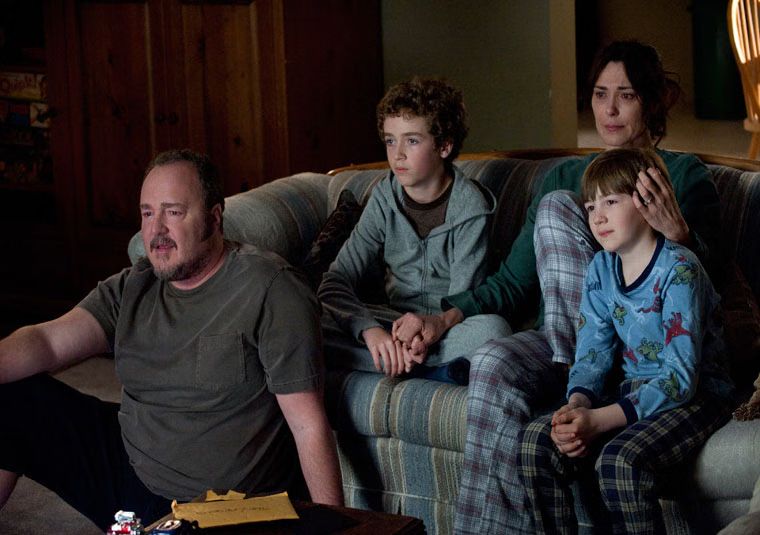
Which brings us back to the victim of the titular killing. In our final moment with the Larsen family, we see the film Rosie had completed just before her death, returned anonymously to the Larsen family by Linden. The film is a silent collection of images: Rosie on the ferry, playing basketball with the Seattle All Stars youths, and narrating her desire to see the world via cue cards. To see the Larsen family, gathered in front of the television amidst smiles and tears, bidding a final farewell to the girl they've all lost, it's hard not to feel genuinely moved, no matter how questionable the earlier episodes were in getting us to this moment, where we actually care about Rosie as an individual and feel the Larsens' grief to the extent that Veena Sud should have intended us to. Yet there it is, the bittersweet contrast of a girl telling of the world she's setting out to see, though we know it's her sentimentality, her need to say a final farewell to the city she called home, that ultimately gets her killed.
As for Linden and Holder, they do the only thing they can do, now that the case is over: go their separate ways. For Holder, there is news of another homicide. For Linden, it's her son, Jack, and the troubling notion that the criminals whose plot truly led to Rosie's murder, Ames and Chief Jackson, will not be prosecuted. Worse still, newly-elected Mayor Darren Richmond the latter criminals into the fold, having helped to get the charges against them dropped. It's Darren's official conversion to the dark side, having given up the possibility of playing the game of politics cleanly, and closing the door on those who care about him, as he does to Gwen in a sequence right out of The Godfather. You could almost hear Richmond telling Gwen, "Don't ask me about my business." He's tried to deny the dirty politician stamp since day one, but what's the use in fighting when the public has already made up its mind? Worse still, what's the use when your own advisers play dirty on your behalf, without your knowledge or consent? Richmond was always fighting a losing battle, even against the show's audience, many of whom assumed he was somehow complicit in Rosie's murder throughout the first season. Darren finally comes to realize how much he's lost, relative to the gain of becoming mayor, and decides that people like Ames and Chief Jackson, though questionable in their morality and business practices, are more useful as allies.
The Killing will ultimately be judged on whether the conclusion rewarded the audience's patience. The clues implicating Terry were there, from her psychological state in the days following Rosie's murder, to her involvement with Michael Ames and Beau Soleil, right down to her flipping out on the older Larsen boy for locking his brother in the trunk of her car, such that it wasn't impossible for an astute viewer to piece together the broad strokes, if not necessarily the specifics. But there were so many red herrings and such indulgence in misdirection and delay that it's hard to argue that the show was a satisfying, worthwhile investment from week-to-week. I feel this show will play a lot better on DVD, in marathon viewings where the audience isn't made to wait a week in-between bombshells and the eventual realization that said bombshell doesn't lead anywhere meaningful. I can't imagine the show will be renewed, but if it somehow is, I feel a third season, with a brand new case, could transform this show into the gritty, nuanced procedural it always had the potential to be. This finale comes the closest to realizing all the crazy potential of the show since the pilot episode; if this marks the end of the series, at least its end was as strong as its beginning.