Revolution - Series Premiere - Video Recap and Review - Pilot
Revolution is the latest in a long line of high-concept hour-long dramas over at NBC, at network that seems to be in love with genre fare (look no further than Grimm, for instance). The last several attempts ultimately failed, with Journeyman, Bionic Woman, and Awake all added to the scrap heap in recent years, to say nothing of how quickly Heroes fell off a cliff. When the network brass refused to allow the show to dump any of its characters to straighten out the narrative, even after the logical conclusion of their arcs, the show stopped being feasible, despite the renaissance of its final season. What had been an interesting, unique show became marred by retreads such as Hiro losing his powers/memory...again, Sylar wrestling with his conscience, and another installment of "Everyone is a Petrelli."
The reason I'm bringing this up is because high-concept NBC serials tend to focus more on the central mystery of the series instead of the characters around which a mystery revolves. Over on ABC, we had Lost, while on FOX we have Fringe. Both were executive produced by JJ Abrams, and while both programs are mythology-heavy, there was a focus on character that superseded the resolution of any centralized mystery, perhaps to the detriment of those shows (but that's a discussion for another day); however, the main point is that, even when the shows were at their most frustrating, the audience remained invested in the characters and their stories, such that the resolution of the mythology surrounding them was immaterial to the casual viewer's own enjoyment of the story. On the other hand, with NBC, we're usually rooted in what's happened and why, and less with who it's happened to.
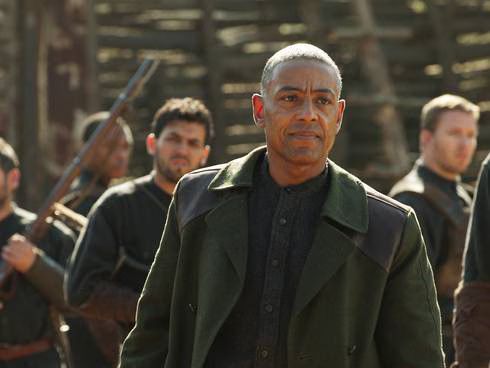
Thankfully, Revolution seems to take its cue from the better series of Abrams and creator/showrunner Eric Kripke. Kripke, who also created Supernatural, goes a long way in establishing trust with the audience. The show is going to be built upon a very large foundation of mythology, but the central question seems less material to the story than the narrative of the characters involved. This approach gives me considerable hope for the series, if for no other reason than I have no idea what explanation they could possibly offer that would explain the dramatic premise of the series.
The premise in question is what shape the world would take following a permanent worldwide blackout. One day, all the world's electronics stop working, from your lower-level tech such as TVs and refrigerators, to essentials like airplanes and hospital equipment. Car batteries and engines fail, even automatic weaponry is a thing of the past. Opening on an intercut between Chicago, Illinois and Port Royal, South Carolina, we meet Ben Matheson (Tim Guinee), who comes home in a panic, stating that "it" has started, and they don't have much time. Ben calls his brother, Miles (Billy Burke), who is on the road with an unnamed companion, presumably to warn him about the coming blackout. The phone dies, and the Matheson household loses power, sending Ben's wife (Elizabeth Mitchell) and children, daughter Charlie and son Danny, into a panic. Flash-forward fifteen years, and the community has adopted an agrarian approach to society, growing their own food and maintaining their own fields and gardens. Charlie (Tracy Spiridakos) is now all grown-up, and she and her brother, Danny (Graham Rogers), go on rummaging expeditions under the guise of hunting. Danny is an asthmatic young man, and so Charlie feels it incumbent upon herself to look after him.
Turns out she's not so great at it.
While reminiscing about the past in her secret spot (looking through postcards in her old Return of the Jedi lunch pail, stealthily winning my heart already), a militia led by Captain Tom Neville (Giancarlo Esposito) arrives to take Ben into custody, along with his brother, Miles. Ben hasn't seen Miles in years, and so Ben offers to go with them himself, but not before giving a mysterious necklace to his friend Aaron for safekeeping. Danny panics, however, and draws a crossbow, leading to a dramatic standoff with the militia. When the other townspeople come to Danny's defense, all hell breaks loose, Danny gets taken by the militia, and Ben is shot dead. Charlie happens upon the scene just in time to say goodbye to her father, and to receive her mission objective: go to Chicago and find Miles. Also, get your brother back, I guess. That goes without saying.
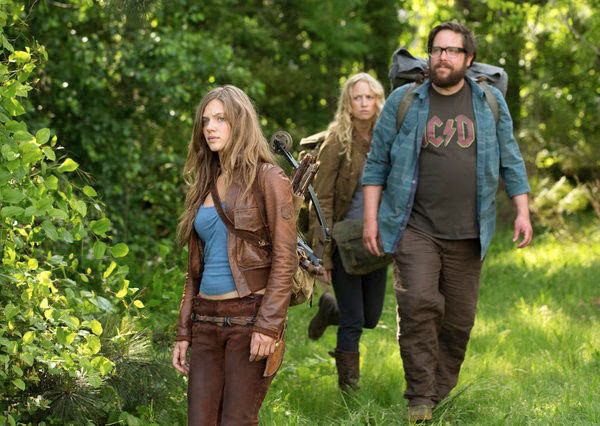
And so Charlie sets off with:
Maggie (Anna Lise Phillips): a doctor with whom her father had become involved romantically following her mother's "death" (I put death in quotes because they wouldn't cast an actress like Elizabeth Mitchell to play Mrs. Matheson if her role is simply going to be in flashbacks)
Aaron (Zak Orth): a former Google executive with $80 million in the bank, who'd trade it all for a roll of Charmin.
Nate Walker (J.D. Pardo): a handsome young stranger who rescues Charlie from a group of marauders/would-be rapists.
The show is visually stunning in places, such as when we arrive in the ruins of Chicago to see Wrigley Field overrun with vegetation, or highways and churches submerged underwater, steepened like a tea bag beneath the grimy green deep. Even the agrarian community the group leaves is a wonderful bit of set design, melding the visual flair of modernity with the aesthetic of a Pre-Industrial agricultural society. The garden under the hood of a rusted out car, in particular, was an amusing image for modern sensibilities, in addition to the horses roaming the suburban dirt road. I would also be remiss in failing to mention the ruined Grand Hotel in which Miles Matheson makes his base. It's just a stunning setting, with crumbled columns and musty antiques. The visual component is probably the most difficult aspect of the show, given the ambitious nature of the series, making the visual panache on display all the more impressive.
Credit: NBC
That said, there are some narrative concerns. I like that the story is focused on the Matheson family and its relationships, as our central three travelers are all united by their love and respect for late patriarch Ben. Even the characters who aren't directly tied to that conceit are compelling, particularly Miles, who could potentially be the show's big breakout character. His climactic sword fight against the militia is something to behold, for network television, and his wry observations and general composure communicates more than was probably on the page. When I woke up this morning, I didn't expect I'd be writing that Bella Swan's dad is TV's biggest badass this side of Mike Ehrmantraut, yet here we are. However, the concerns come in the form of the plot's moving objectives.
An objective that isn't set in stone is fine, but the obscure nature of the objective itself could turn out to be a problem, since there's no real indication of where the series might be headed. Granted, we're only one episode in, but even in the broadest mythology-based shows, there's some sense of an overarching narrative. An endgame. With Heroes, we were setting up the showdown with Sylar and the union of all these disparate characters towards that common goal. In Lost, the objective was to find a way off the island. The end game was clear, in each respect. Only after the goal was established did the writers start throwing wrenches into the framework. Here, we've gotten the wrenches right off the bat. Danny escapes the militia and hides out with Grace (Maria Howell), a former algebra teacher who also has a necklace like the one Ben Matheson gave to Aaron. After Danny is recaptured, Grace goes to the attic of her house and uses the necklace to activate a makeshift computer, through which she has a text-based conversation with an unknown party. Right away we're introducing elements that factor into the overall mythology (a necklace with a pendant that activates electronics) without any sense of what it means to the current objective (find Danny). In essence, there's too much introduced here, without even getting into the objective-in-motion that is Danny. I fear this season might be set up to feature a Game of Thrones-esque trek where no one ever really gets where they're going. Just new objectives interrupting the old objectives and complicating matters without ever moving the story forward.
If it sounds like I'm complaining, it's only because I really loved this pilot and want to see the show succeed in doing something beyond the pale of the usual genre fare. There's potentially a great show here, with plenty to recommend. Giancarlo Esposito (who, thankfully, is in everything these days) is a highlight as the villain, and the revelation of the identity of his boss, the mysterious General Monroe, a warlord and sovereign of the Monroe Republic, is a great stinger towards the episode's end. The camaraderie between the ensemble, faint though it is at this point, is palpable as well, even if their individual performances leave something to be desired.
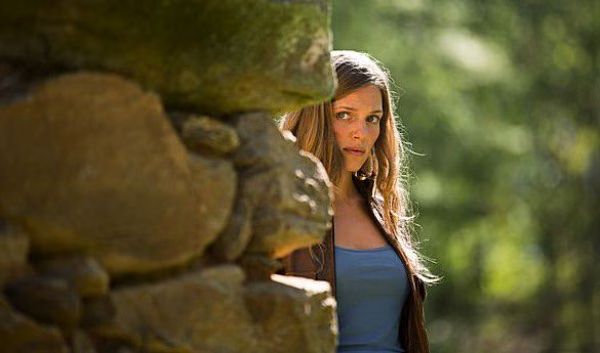
I genuinely feel they have something with Tracy Spiridakos, even if I wasn't feeling her performance all the way through. As Charlie, Spiridakos has the potential to become to Revolution what Hayden Panetierre became to Heroes: that recognizable, public face of the program. The star, more or less. Because I don't see this as a show that is necessarily designed to have just one star. It comes across as more of an ensemble piece, and I really hope that's the direction it takes. A character-based focus could help anchor the show when the mythology inevitably gets out of hand. That said, Revolution is my favorite new show so far this season. I'd certainly recommend checking it out (I've embedded the complete episode through NBC below), since there isn't really anything else like it on TV right now, except maybe Falling Skies, and even then, they have very different approaches. If nothing else, it's worth it for the spectacle, at least at this point. The show will have to evolve beyond spectacle if it's going to be a success. And I certainly hope it will be.