Revolution - Season 1 Episode 6 - Recap Video and Review - Sex and Drugs
Well, it took forever for Hurricane Sandy to wind its way past my neighborhood so that we could start the process of getting the power back on. (Hope everyone has stayed safe and dry!) After having watched the latest Revolution on demand, I have to say that "Sex and Drugs" is a solid hit, even if it's not really essential to the overall quest narrative. At least not the plot at its center, which sees Aaron (Zak Orth) begin the process of getting over his lingering inability to protect the ones he loves. Nor is Charlie (Tracy Spiridakos) learning, to her terror, that maybe she can be just as cold-blooded as her uncle essential to the overarching story being told. However, that is not to say that either plotline isn't essential at all. They're simply essential in different ways, to different aspects of the story being told. In brief, though the episode doesn't bring our party appreciably closer to the goal of rescuing Danny (Graham Rogers), "Sex and Drugs" becomes one of the season's most relevant hours of the season by further developing these characters by giving them depth beyond their objective.

The episode picks up almost immediately after "Soul Train", with Nora (Daniella Alonso) slowly succumbing to the stab wound she suffered from Rebel operative Hutch (Jeff Fahey). With Nora's wound becoming infected and time slipping away, Miles (Billy Burke) hijacks a milita transport in an awesome opening setpiece sequence, and gathering the gang together to make for the palatial estate of one of Miles' old contacts, a man named Drexel (Todd Stashwick). Naturally, this being a lawless, heathen society, Miles and company receive about as far from a warm welcome as one could expect, with Drexel shoving Miles to his knees, putting a gun to his head, and pulling a "Bang!" stunt, claiming it's all "fun and games" (a recurring saying for Drexel throughout the episode, and an ideology that leads to his downfall). Drexel, the most unambiguously, borderline-cartoonishly sinister villain in the series thus far, is a pimp and drug-peddler with whom Miles had a business relationship in his days as a general for the Monroe Republic, until he left Drexel holding the bag after a particularly dangerous operation. Drexel has held a grudge ever since, and it motivates much of his behavior throughout the episode, even though it's just as likely he'd have treated them every bit as badly, since we're given to understanding that this is the kind of person Drexel is, and likely always has been, with the lawlessness of a decayed society finally giving him the free reign to be as bad as he wants to be.
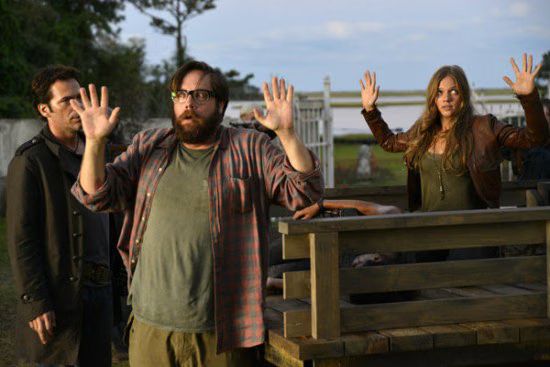
Drexel has his own private militia, from the looks of things, but thankfully for Nora, he also has his own on-site medical staff, including a doctor with a host of amenities such as homegrown penicillin. While the doctor goes about treating Nora, Drexel makes Miles and company his prisoners, and it's during this hostage situation that we're treated to an exploration of Charlie and Aaron's motivations, with the latter occurring mostly through flashbacks. Aaron appeared to be conceived, initially, as the comic relief of the group, the one man in the party whose C3PO-esque bumbling would offset his natural intellect for electronics (as the most tech-savvy of our travelers). Yet the series never really pursued that avenue for Aaron, and this characterization proved to be just an expectation due to the genre. The series is well-served by taking Aaron in a different direction entirely, figuring him as more of a Hurley-esque sad sack, whose inability to protect those he loves, coupled with his readily-apparent uselessness, make for a more richly-nuanced character than perhaps any of the other protagonists on the show thus far.

But first, Charlie. She's still reeling from failing to rescue Danny during the train heist. This, in its totality with the death of Maggie, the loss of her mother, and her failure to save her father, sends Charlie over the edge. She rips up her postcards, emblematic of the world before the Blackout, and agrees to Drexel's proposition: he'll let them go if Charlie agrees to murder O'Halloran, an ex-cop who burned down Drexel's poppy fields in retaliation for his daughter's murder. The murder plan involves Charlie pretending to be one of Drexel's girls, battered into abandoning him and giving up info for his enemies. Drexel wallops Charlie to sell the con, further cementing his bug-eyed supervillainy, though Charlie herself does a fine job selling the fiction to O'Halloran's guards. Charlie resolves to go through with the killing, even going so far as to improvise by sleekly grabbing a letter opener when she loses her initial murder weapon. But she struggles to go through with it. O'Halloran is essentially a good man: he was legitimately wronged by Drexel, who turned his daughter into a heroin addict and then sent back her body when he was done with her. He's also a family man, with grandchildren and a welcoming disposition. She goes through with the attack, rendering O'Halloran unconscious with a lucky blow. Charlie, who's been fighting against falling into total moral ruin throughout the episode, out of a notion of having to do it for the greater good of her mission, is about to finish the ex-cop when Miles intervenes and prevents his niece from completely succumbing to her baser nature. It's a harrowing bit of business, but the fact remains that Charlie's hand was coming down for the killing blow before Miles came to the rescue, so who knows what kind of damage it would have done to Charlie, psychologically, for her to have killed a good man on the say-so of a sadist? All things considered, it's an interesting prospect to push Charlie closer and closer to the edge, at the cost of her innocence. It's likely the most compelling thing they can do with the character at this early stage of the series. An ethical dilemma is always good for telling us just who a character is.
Credit: NBC
Aaron's dilemma, meanwhile, is of a more existential nature: am I necessary? It's almost meta, when you think about it. It's a character questioning his value to the narrative, and the episode is relatively ballsy in exploring what purpose Aaron actually serves, if any at all. Before the Blackout, Aaron was a high-rolling Google exec who could pay to give his beautiful wife anything and everything she could ever want. For her part, Aaron's wife seems to simply love Aaron for who he is, and doesn't seem to care that he's not exactly Bear Grylls when it comes to surviving in a tech-free society. But Aaron can't get over his angst and self-doubt after he and his wife are attacked by a group of marauders, and he's powerless to stop them, relying upon the intervention of a roving group of good Samaritans. We already know from Aaron's back story that part of his angst about an electricity-free society isn't so much that he's no longer rich, but that brains no longer matter when pitted against brawn. The world is now one big grade school playground, and Aaron never fared well in such environments.
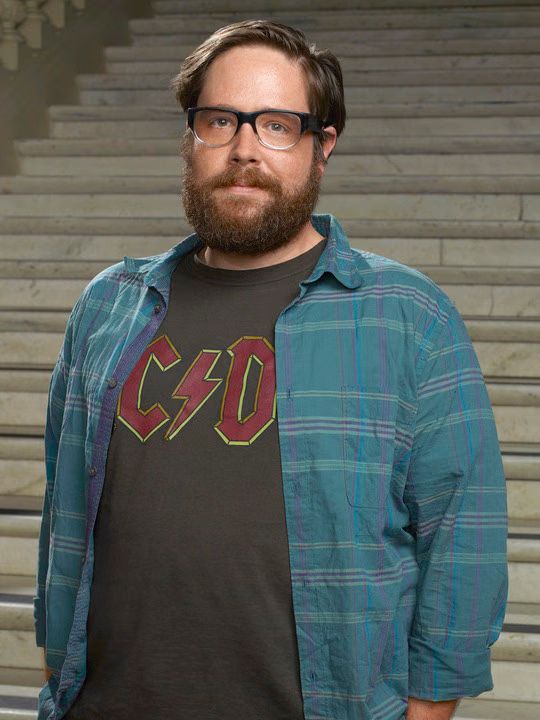
That said, while this is a character issue worth exploring, it's kind of ridiculous that Aaron chooses to leave his wife with the benevolent strangers, rationalizing that they could protect her, whereas he would just fail to do anything right. By not joining the group of survivalists, Aaron essentially allows himself to live in perpetual ignorance about how to do anything. Couldn't he have just joined the group with his wife, and learned survival skills from the pros, instead of abandoning his wife and leaving to fend for his own? It's a small miracle he wasn't killed in the first hour after leaving the group. I probably wouldn't last too long myself, but then I never would have abandoned my wife in the first place. I'd have found ways to contribute to the group, whether by gathering firewood, looking for whatever, or keeping night watch. If nothing else, I'd have stayed just so my wife wouldn't have had to be alone in a wild, confusing new world. For as much as the writers do for the Aaron character, his motivations for leaving are profoundly stupid, and he doesn't appear to have grown any more resourceful in the intervening fifteen years other than in his resolve and ingenuity.
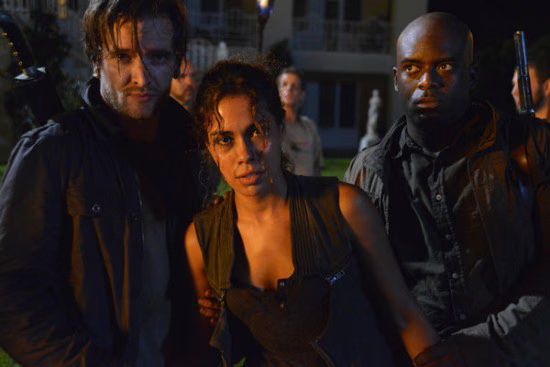
Aaron claims to have a plan to get he and Nora out of their predicament with Drexel, and this is another misstep on the writers' part, as it's predicated on Aaron somehow knowing ahead of time that Drexel was going to force he and Nora to play a twisted game in which whoever shoots the other first is free to go. Aaron insists that Nora shoot him, claiming that he's pretty much useless, and this echoes Aaron's conversation with Miles, in which he tearfully pleads with Miles to go after Charlie, claiming that she's his family too. It's Zak Orth's best moment in the series, and it's a shame that the writing around it occasionally falters as it does. He really does elevate some questionable material. That said, the conclusion, in which Aaron shoots himself in the heart, only to reveal that he deflected the bullet with a flask, is great. Particularly because it results in Aaron shooting Drexel and killing him. Drexel's death is alarmingly cathartic, and it's even better that the least likely member of the group to kill anybody is the one to do it. Better still is the fact that Drexel's former crew just lets him and Nora go, unmolested. It's a hell of a sequence that was enough to make me look past the occasional gaffe in the writing.
