Man of Steel - Review
Credit: Warner Bros. Pictures
Review of Man of Steel
It takes a certain amount of boldness to take a character as culturally ingrained as Superman and change certain fundamental aspects of what we've come to accept about him. Yet, with Man of Steel, director Zack Snyder and screenwriter David S. Goyer have made a Superman movie that recontextualizes the character. While this new take on the Superman mythos succeeds far beyond its shortcomings, it's those shortcomings that prevent the film from achieving true greatness. Man of Steel is not a bad movie at all. It's simply something different, not entirely like the messianic figure at its center.
Credit: Warner Bros. Pictures
The story centers on Clark Kent's alien heritage as Kal-El, the last son of Krypton. While this isn't really all that different from your standard big-screen Superman story, Man of Steel takes things a step further by making the narrative entirely about that alien heritage. We hardly spend any time in the old haunts of prior Superman films. Sure, we get to chill in The Daily Planet for a spell, and Metropolis figures into some of the most exciting portions of the movie, but to get to the heart of who Clark Kent/Kal-El is, we have to understand how he's been shaped by his two homes: Krypton and Smallville, Kansas.
Credit: Warner Bros. Pictures
The prologue details the fall of Krytpon, which is an origin story as intrinsic as the Superman character itself. Jor-El (Russell Crowe) is a hard-edged scientist whose pleas to evacuate Krypton fall on deaf ears. The government of the planet has mined the natural resources to such an excessive extent that the planet's core has been compromised. There isn't time left to save the current inhabitants, but if they act quickly, Jor El argues, they can preserve the Kryptonian species. However, while Jor-El has an ally in General Zod (Michael Shannon), the warrior's tactics are far more aggressive in nature. This difference in approach puts the men at odds, and results in an extended sequence that makes the opening on Krypton the best part of the movie, which surprises me to write. But even now, looking back, I find myself connecting most strongly with those opening moments, as the film takes a hardline approach on the subject of the greater good. It's a theme that runs throughout the film, yet it's a subtext that resonates most strongly here.
Credit: Warner Bros. Pictures
However, Clark's origin story on Earth also manages to be fascinating, thanks in large part to Kevin Costner and Diane Lane as Jonathan and Martha Kent, the couple that discovered Clark in a field and raised him as their own. There's terrific warmth in both performances, and the interactions with a young Clark (Dylan Sprayberry) illustrate the film's other resonant themes, such as acceptance and destiny. Of course, to do this, the film eschews much of the accepted backstory of the man who would be Superman. Clark Kent essentially becomes an aimless drifter, falsifying work records in order to get odd jobs here and there, some of which allow him to research his Kryptonian heritage. This isn't bad in and of itself, but Snyder and Goyer needlessly complicate things by taking a non-chronological approach to Clark's backstory. I honestly can't think of any reason for why the film would need to jump around to scenes in Clark's past throughout the film, instead of simply dispensing with those elements in the first half of the film. It's a puzzling approach that doesn't entirely work, and it kicks off one of the more hit-or-miss parts of the film, as Clark meets Lois Lane (Amy Adams) and begins to learn more about his alien heritage. In essence, it's Superman learning how to become Superman, yet it's not nearly as impactful as one would expect it to be. To avoid completely recapping the movie, I'll simply say that the film picks up considerably once we're over the hurdle of Clark discovering his history.
Credit: Warner Bros. Pictures
I imagine audiences will split on Henry Cavill. His Clark Kent/Superman isn't the most charismatic superhero on the silver screen today, but then I'm not entirely sure Superman has ever been all that charismatic a guy. He doesn't really make many quips like your average Marvel superhero might, nor does he really make a habit of talking about his feelings outright. At least not as an adult. This makes for a stoic portrayal, yet Cavill does a remarkably solid job with everything he's given. He certainly looks the part, more so than any actor who's donned the iconic outfit since Christopher Reeve. Moreover, he brings an aura of nobility and grace to the portrayal that does much of the work of endearing us to him, beyond the myriad opportunities the script takes to show his heroism on-screen. However, while Cavill is tremendous at embodying the outsider aspects of the Clark Kent/Superman character, he ultimately comes up short in balancing the dichotomy between the two halves of that identity -- but I'm not even sure that's his fault so much as the script's. Clark Kent is the real identity, while Superman is the mask. Yet it's the other way around here, as Clark Kent is merely the face Kal-El wears when he's not Kal-El, the last born son of Krypton. But this was the only element I found jarring about Cavill's performance, as he's quite solid otherwise, particularly because he's so good at blending in. It's hard work getting audiences to buy that women from Kansas to Nova Scotia would completely overlook a guy that handsome.
Credit: Warner Bros. Pictures
Michael Shannon is also solid, though hammy, as General Zod. It's a role that doesn't have a lot of nuance to it, yet Shannon finds a way to make Zod's animus towards Superman to almost feel relatable, in some respects. He's a threatening man, but he's also far more desperate than he leads on, and Shannon does a remarkable job at striking that tenuous balance. He's the polar opposite of Russell Crowe's Jor-El, and that contrast makes for great interplay for those brief scenes they share together, as Crowe's stoicism in the face of calamity draws further attention to just how crazed Zod has become from the friend Jor-El once knew. Thankfully, because Crowe's measured performance is somewhat mirrored in Cavill's approach, the interactions between Zod and Superman feel just as emotionally charged.
Credit: Warner Bros. Pictures
Credit: Warner Bros. Pictures
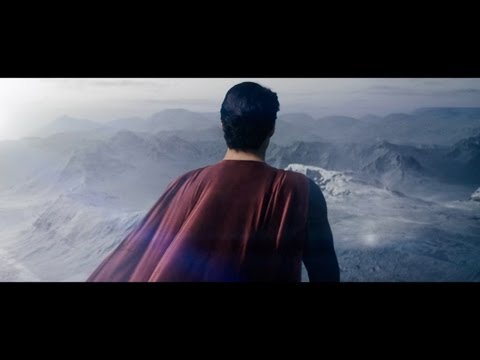
Of course, the one thing Man of Steel absolutely nails is its presentation. This has always been a strong suit for Snyder, who's made stylized green-screen effects a part of his signature cinematic flair. From that approach, the film is simply gorgeous to look at, from the high-fantasy look of Krypton, to the arctic tundras. Even isolated shots of the Man of Steel are visual splendors, as the cinematography really captures the iconic look of Superman. I'd argue you could take just about any frame of the film with Superman in it and make a marvelous comic book cover that exemplifies the spirit of the character. The Superman world allows Snyder a veritable playground for his sensibilities, as he occasionally ditches the green-screen in order to lay waste to real backdrops, such as a Kansas city block, or huge, fifty-storey skyscrapers. Sure, the CG effects are still heavily in play, and occasionally risk coming across as a videogame (particularly in the latter third of the movie, which veers back and forth between visual majesty and live-action cartoon). But the effects are in service to the story, adding not only a momentous sense of danger and destruction, but also illustrating the stakes involved. If the effects had been in service to a better story, the film might have been a total home run.
Credit: Warner Bros. Pictures
Naturally, it can be a bit of a hard sell to get audiences to carry about a nigh-unkillable messiah. He's not as vulnerable a figure as Batman or Iron Man, and making him a similarly tortured figure would ring false for the character. This is not to say that Superman isn't capable of a certain level of psychological complexity. But it's just not the kind of depth that plays well on-screen, in most cases. It's more something that plays beneath the surface, gnawing at Superman's psyche, but it's something that's hard to portray. It's even harder when the film decides to jettison nearly all character-based storytelling in favor of exhausting, excessive bombast. After a while, I sort of just gave up on the idea that the action was ever going to end. And with a 148 minute runtime, I don't know if it was that good of an idea to stack so much action onto the back end of the film, as opposed to a more even distribution of the big setpieces. Of course, this is a summer blockbuster, and the action offers some of the most eye-popping sequences you'll see on-screen this year, but there's something to be said for moderation.
Credit: Warner Bros. Pictures
That said, I do like certain aspects of what the film does with Clark's character, such as the assault on Clark's senses when his powers manifest as a childhood, or his connection to Zod, as the two men are irrevocably bound to the duty prescribed by their destinies. But that's also one of the story's weaknesses, as Superman just isn't a very proactive character here. Things happen, he reacts to them, and the better part of the movie is spent dealing with the fallout of those reactions, but none of those reactions are choices, save for one choice at the end that's likely to infuriate more longtime Superman fans than impress them. But ultimately, the film wraps back around to making Clark Kent/Kal-El/Superman an interesting character by giving us a peek at what a more traditional take on the character would look like. If nothing else, that has me anxious for the sequel, as I think there's genuine potential for a perfect Superman movie with this cast, particularly Cavill, whom I feel has only scratched the surface of what he's capable of doing in the role.
Credit: Warner Bros. Pictures
Man of Steel is by no means a bad movie, as it not only provides some of the most eye-popping sequences you'll see in a movie this year, but it also offers up an interesting new take on an iconic figure. I would also be remiss if I didn't mention Hans Zimmer's wonderful score, which offers epic scale and considerable intimacy in equal measure, lending excitement and poignancy to the proceedings. But there was potential for far more than what made it to the screen with this film. Hopefully, the sequel realizes that potential, since there's a lot of unmined depth to the Superman mythos that would make for a more complete experience.