Mad Men - Recap: Perception vs. Reality
Recap video and review of Mad Men - Season 6 Episode 10 - A Tale of Two Cities:
Since SCDP merged with CGC, it's been somewhat surprising just how fluid the partnership has been. I don't know that anyone was really expecting a smooth integration between the two companies, yet that's more or less what we've had, with both sides working together towards a common goal. As a show that thrives on duality, it's unsurprising that Mad Men would opt to depict the merged SCDPCGC as a company that, on the surface, is a well-oiled machine that understands that all business is their business. However, things are considerably less fluid beneath that veneer of cooperation, as an Us vs. Them mentality pervades, despite the willingness of most parties to join business. The irony of this is that the Us vs. Them rivalry is the product of one man's paranoia: Jim Cutler (Harry Hamlin), who insists that the only way for CGC to survive is to obtain business from and neutralize the presence of SCDP employees, yet Ted Chaough (Kevin Rahm) doesn't see things that way. It sparks an episode-long investigation into perception, and whether or not that perception is reality. It starts with SCDPCGC looking into deciding on a name, because their current merged title is a mouthful. The episode then ends with Pete (Vincent Kartheiser) bucking others perception of him as a rigid, obstinate ad man, and smoking a joint in the office. While the latter development is more reactionary than the former (since Pete had just gotten a stern talking-to from Don, following a day in which nothing really goes his way, from a business standpoint), the show luxuriates in the dichotomy, allowing viewers to read a scene one way or another, and allowing for either reading to be valid. "A Tale of Two Cities" is an engaging exercise in perception, and a solid episode all-around.
Credit: AMC
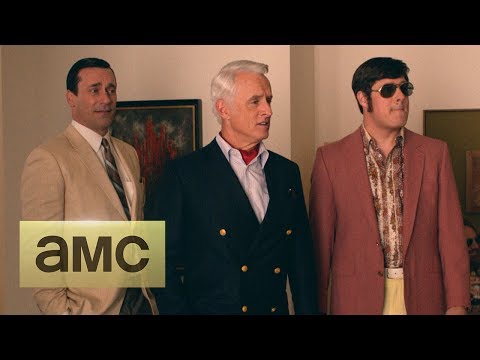
Don (Jon Hamm) and Roger (John Slattery) are headed to California on business with Harry (Rich Sommer), and Roger believes that the Californians' perception of a big New York firm will do all the work for them. “Be slick. Be glib. Be you,” Roger tells Don. “Our biggest challenge is to not get syphilis.” Of course, the assumption that they'll simply waltz in and use their NY cred to charm the pants off of Carnation proves to be unfounded, as the pitch isn't the cakewalk Roger expected. Carnation is worried about the ad campaigns for Life cereal and the Instant Breakfast drink coming into direct conflict with one another. Though Don makes a clever observation about how the two products are different (cereal is for kids, Instant Breakfast is for adults), the head executive at Carnation isn't nearly as impressed with SCDP as they are with themselves. He states that all NY ad agencies are the same. They put on airs when trying to win your business, but then they're always out to lunch when you try to call them. They then conveniently wait until you're out to lunch before returning your call. In essence, NY agencies can't be trusted to do the work necessary to make a partnership with a client successful. Roger, however, makes a fitting recovery by saying he's sorry their "last girlfriend" hurt them, "but we're in your office right now." Sold on the willingness of SCDP to work, the Carnation men open the floor for a pitch.
Credit: AMC
Threaded within this storyline is coverage of the protest riots at the 1968 Democratic National Convention, in which an assembly to protest the DNC resulted in police forces battling with the protesters for control of Chicago's streets. The news coverage is a violent melange of images, and it affects both Megan (Jessica Pare) and Joan (Christina Hendricks), though Don seems relatively nonplussed by the carnage. He continues his California trip, stopping off at a party that a friend of Harry's over at CBS has gotten them access to, and it's there that things get out of control.
Roger initially has fun at the expense of his ex cousin-in-law/employee, Danny Siegel, who's no less diminutive than the last time we saw him, prompting Roger to indulge in an endless string of bad short person jokes. However, Danny, now a film producer, is able to buck Roger's perception of him as a nonviolent subject of ridicule by punching him in the nuts and leaving with the girl they'd gotten into an argument over -- the enigmatic, mostly-silent Lotus. It's a funny bit of business that happily distracts from Don's time among the hippies at the party. At the suggestion of a beautiful blonde at the party, Don partakes of some hashish and experiences a drug-induced illusion of Megan, dressed head-to-toe in hippie threads. Dream Megan announces to Don that she has a surprise for him, touching her belly. “Really?" Don says, mystified at the prospect of becoming a father again. "What do you think it is?” he asks Megan. “A second chance,” she responds, before leading him through the lavish California estate where the party is taking place. Before long, Dream Megan is replaced by the ghost of PFC Dinkins, in full military regalia. The private, now missing an arm, lights Don's cigarette with the lighter he'd accidentally given him in the season premiere. Dinkins states that his wife thinks he's MIA, but he's actually dead. Don responds by asking Dinkins why he's still missing an arm if he's dead. “Dying doesn’t make you whole," Dinkins says. "You should see what you look like.” He leads Don to the pool, where Don is floating face down -- at which point, Don is revived from this extended hallucination by Roger, who has saved Don's life by fishing him out of the pool and flushing the water from his lungs. Though Don's perception of himself is as a cool-handed man of the world, he's not nearly as well-adjusted or efficient as he sees himself, and the disconnect between his self-perception and reality gets him into trouble far more often than not (look no further than his shallow attempts to hold on to Sylvia Rosen, a woman who is no longer as mystified by Don as he seems to expect her to be).
With Don, Roger and Harry tending to business in California, things have gotten frantic in the office. Bob Benson (James Wolk) remains as ambitious as ever, psyching himself up in his office to a record of How I Raised Myself from Failure to Success in Selling, and his motivational education pays off when Ginsberg (Ben Feldman) gets a panic attack moments before their meeting with Manischewitz, a wine brand. Though Bob is able to use his chipper, go-getter attitude to convince Ginsberg to take the meeting, the meeting goes disastrously. Manischewitz is likely to abandon ship, leaving Bob feeling that he's failed. However, Cutler takes it upon himself to elevate Bob to the Chevy account, a promotion that's sure to create some waves internally. Looks like Bob's career-climbing is working like a charm, as he's worked hard to be perceived as a trustworthy hand who's always on the side of whomever enlists his aid. It's a tenuous position to hold onto, but Bob is negotiating that precariousness with delicacy. Although, for all we know, maybe Bob is really just a good guy with good intentions. But it strains credulity. He's just too perfect, in some respects.
Credit: AMC
While Bob is effective at changing his perception within the office, Joan is considerably less successful. When a friend introduces her to a high-ranking Avon exec, Joan takes the meeting to attempt to reel in her first big client since being made a partner last season. The impetus behind her ambition to bring in business is the perception that she's only attained her position in the company by having slept with Herb from Jaguar. This is Joan's chance to prove herself by bringing in a client, so that no one has cause to ask her why she's a partner if most of what she does is just glorified secretarial work (at least to those who don't realize just how much she's done for the company). The first meeting with the Avon exec goes well, and Joan tries to secure Peggy as the creative mind behind the team. But Ted quickly takes the account away from Joan, giving it to Peggy and Pete. Thus, Joan, fearing that Pete will get all the credit for the account, decides to set up the meeting without Pete's knowledge, inviting Peggy alone. Joan frequently steps on Peggy's attempts at connecting with the Avon executive during their breakfast meeting, though the meeting generally goes pretty well, all things considered. The Avon executive seems open to working with SCDP, although Peggy implies that Joan having broken with protocol could mean the loss of the client. The two women get into an intense argument, with Peggy accusing Joan of looking down her nose at her, before implying that she only has her position because of Herb, a statement she immediately revokes and apologizes for. But it's too late. However, Joan has bigger fish to fry than a personal slight.
Credit: AMC
When Pete discovers what Joan has done, he laces into her and brings in Ted to give her the third degree as well. Peggy listens to all of this through the comm in Joan's office, and it sounds as if Joan is coming perilously close to being fired. This is built up by Jim Cutler spending much of the episode saying that the company needs to cut a few SCDP people loose. Thankfully, Peggy intercedes on Joan's behalf by sending Joan's secretary, Meredith, into the conference room with a message: the Avon executive is on the phone and he wants to talk to Joan. Having heard that Joan has established a partnership with the Avon man, Ted allows Joan's break with protocol to stand, to Pete's complete outrage. Of course, the Avon man wasn't actually on the line, but hey, Peggy and Joan are back to being relatively cool with each other. However, Peggy warns Joan about the perils of her ambitions, saying, "You better hope he really calls." Joan stands, alone in her office, with tears forming in her eyes, having mortgaged her entire career on the prospect of legitimizing her standing in the company -- because, partner or not, she felt she needed to justify her title with a big business acquisition. Only time will tell if she's delivered. Pete, meanwhile, gets told off by Don, who has no interest in hearing Pete whine about the new company new, Sterling Cooper & Partners. Don tells him that if he doesn't like the business, it might be time for Pete to get out of it. And so Pete, in a huff (no pun intended), takes Stan's (Jay R. Ferguson) marijuana cigarette and has a smoke as the world slows and Janis Joplin kicks in over the closing credits. Pete has done what he can to earn respect in the company, but he's accosted by a pervasive sense that he isn't respected at all, and that his perception within the company isn't reflective of the value he brings to it. I can certainly understand why he'd feel that way, given how much business he's brought in. But then again, there's a certain satisfaction that comes from watching Pete Campbell lose.
Credit: Michael Yarish/AMC
"A Tale of Two Cities" explores how perception shapes the ways in which these characters act and respond to their world. While not exactly the most riveting hour of television, it remained compelling throughout. Mad Men continues to be among TV's best character studies, allowing for storytelling that issues from the characters who are affected.