Grimm - Season 2 Episode 2 - Recap and Review - The Kiss
Grimm returns with “The Kiss,” the second half of the season premiere's two-part story arc (well, three parts, if you count the season one finale), attempting to weave a trove of disparate plotlines into a cohesive whole. Frankly, it ends up becoming quite a big mess. But it's an admirable mess, since it actually thinks outside its own box. As conceived, Grimm is a show that follows the strictures of the police procedural, introducing a mythological, supernatural fantasy element to set it apart from the Criminal Minds and CSIs of the world. The show has shown a willingness to venture into extended arcs while avoiding outright serialization, resetting from week-to-week with the “case of the week” format that's the bread-and-butter of procedural television. To this end, Grimm has a bit of difficulty maintaining narrative cohesion, as the show's format tends to disallow this kind of serialized storytelling. In short, this would have been a stronger episode had it been the second hour of a two-hour season premiere, as opposed to an episode we had to wait a week for, since so much of this episode's flow is dependent on the momentum of the premiere. As the episode starts, we have to reset and remind everyone where we are in the story, and it proves to be to the episode's detriment. However, it's great to see a show that's willing to take a risk and switch up the ways it chooses to tell its stories. A daring miss is still a success, in my book.
Now onto the episode...
For starters, anyone have any theories on exactly what Captain Renard is? We saw the beginnings of a shifting that looked vaguely like a hexenbiest, but also appeared to be somewhat off. Is he just half Wesen? Is he some type of hybrid creature? Was it merely some kind of hallucination? Renard was among season one's most menacing characters, owing to the complete aura of mystery that surrounded him. I'm a bit disappointed that the solution to his mystery is potentially as simple as it appears to be, but Grimm is a show that seems to have a clear idea of where it's going, and the groundwork had been laid for Renard-as-Wesen since long before I came to review this show, so I can't really argue with the show's methods, although I'd have found it much more interesting for him to simply be human, or perhaps another Grimm (unlikely as those possibilities would be). Ah well, this is why I don't make bets in office pools. Besides, I can't really complain that the show didn't do what I wanted it to do, as that's not how TV works. And hey, if it's a plan the creators are following through, and the plan proves to be in the best interest of the show, going forward, then I'm firmly in the show's corner.
Renard's (Sasha Roiz) plotline was the highlight of this episode, as Adalind's mother Catherine (Jessica Tuck) concocts a formula that will purify his heart, allowing him to awaken Juliette from her coma with a kiss, a development foreshadowed with the opening fairy tale quote (from Sleeping Beauty): “If a man of pure heart were to fall in love with her, that would bring her back to life.” We're given no indication that Renard has actually fallen in love with Juliette (Bitsie Tulloch), but his kiss wakes her just the same. To what end Renard is doing this, we can only speculate. To make matters even more complicated, the potion itself seems to take a terrible toll on the Captain, as he writhes in pain, ripping and tearing at his own clothing and screaming in agony, to say nothing of the aforementioned shifting. If it caused THAT much pain to scrub the impurity from his heart, just how sinister IS Renard? It really calls his motives into question. One would expect that he chose to awaken Juliette as a means of keeping Nick from leaving Portland, so that he and the royals could keep a close watch on him and determine his strength as a threat, or his viability as a tool for their ends. But then why the memory loss?
You see, Juliette awakens briefly after Renard leaves after kissing her, and Nick (David Giuntoli) arrives to find her completely ambulatory and fine...except for the fact that she doesn't appear to remember him at all, despite giving her special eyedrops from Rosalee (Bree Turner) that were created to prevent the memory loss the curse would inflict. This could be a decent excuse to write Juliette out of the show for a while without actually killing her, to keep her on the backburner until she's needed, as there doesn't seem to be much for her to do otherwise. Juliette is problematic in the sense that we were introduced to her as Nick's girlfriend as opposed to being allowed to meet her first as her own independent character, before putting her together with Nick, at which point we could watch their relationship develop organically instead of simply being dropped in the middle of an existing relationship and being told “Here are two people. They love each other. Just go with it.” It's also a chemistry issue between Giuntoli and Tulloch, as it seems almost entirely one-sided, with Nick pining after a woman who's aloof and not really all that into him beyond the simply pleasantry of a polite romantic relationship. It's a strange pairing, to say the least.
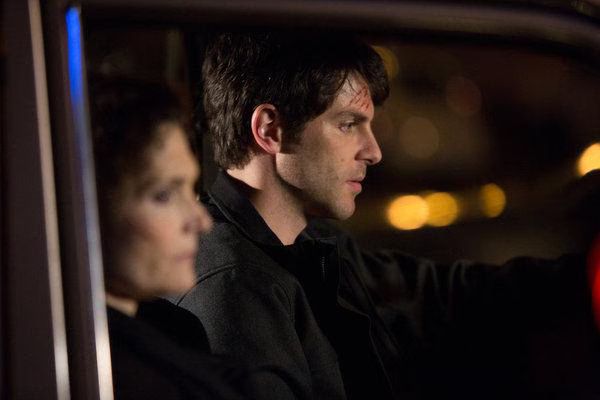
That said, ignoring the Juliette complications, the show gets a lot of things right. Following up on last week's cliffhanger, Nick and his mother, Kelly Burkhardt (Mary Elizabeth Mastrantonio) defeat the Mauvais Dentes. Ms. Burkhardt lands the killing blow in what turns out to be a very well-choreographed fight scene, brief as it is. And it's not even the best fight in the episode, as Kelly and Catherine duke it out, with Nick's mother eventually winning out in a thrilling matchup that has the neighbors calling the cops over the crazed ruckus it makes. Though the episode wasn't narratively as strong as the premiere, it more than made up the difference through the quality of its action, with tight fight choreography and the feeling of genuine stakes.
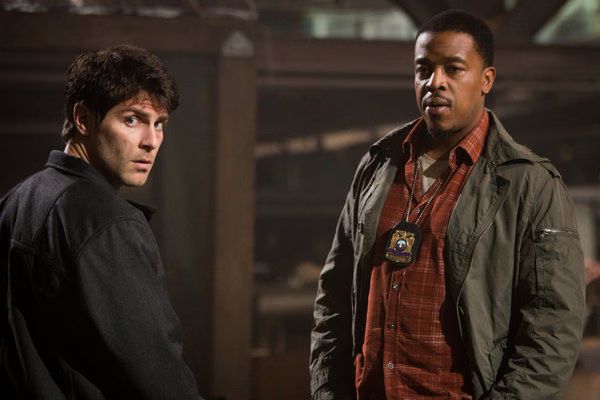
The two killings draw the scrutiny of the FBI on Nick, who must deflect their accusations. Renard even stands up for Nick, putting the FBI agents in their place over their combative line of questioning. Here, we're shown the divided loyalties of a man who's a cop and also a Grimm. It's analogous to the divided loyalties Nick has towards his mother, on one end, and the other constants of his life (Rosalee, Monroe, Hank, even Juliette) on the other. Those divided loyalties are reconciled by episode's end, with Nick helping his mother to escape Portland with the Fuchsbau coins. After the dual killings, it's no longer safe for her to stay. Of course, it's not enough for Kelly Burkhardt to just leave town on the train – no, she has to steal a car. Those crazy Burkhardts...
“The Kiss” doesn't entirely succeed in fulfilling the promise shown in the season premiere, though it deserves commendation in its own right, as it dared to tell a different kind of story than the “case of the week” procedural that Grimm is so adept at telling. In this sense, even though the episode is ultimately a bit of a plodding mess, with pacing issues out the wazoo, it still remains a thoroughly entertaining hour that builds real anticipation for the continuation of the Renard arc, silly amnesia subplot aside. That's really about as good as you can ask for this early in a show's sophomore season, particularly when it's in the process of living up to a commercially-lauded first season. It'll be interesting to see where the plots go from here on out, and who else gets let in on Nick's secret double life.