Elementary - Series Premiere - Recap and Review
Well, let's get the obvious right out of the way. The Holmes of CBS's Elementary is not Benedict Cumberbatch's Sherlock, and he doesn't really try to be, either. Jonny Lee Miller plays Holmes as a man unhinged, every bit as likely to blindside a parked car in a fit of rage as he is to provide valuable insight into an investigation. However, this portrayal works because of the very different kind of show Elementary is right from the start. When an American network orders a pilot to series, it's likely with a preliminary 13-episode order, with an option for a full season pickup of around 22 episodes. BBC's Sherlock has no such issue, with its three episode seasons at 90 minutes each. There's more narrative freedom in telling larger arcs in such smaller, contained story spaces. Yet Elementary succeeds by distancing itself as much as possible from the show that likely got this pilot ordered to series in the first place. Yes, Elementary is in CBS's signature genre: the crime procedural. However, unlike similar shows in the network's lineup, Elementary eschews the standards of forensic science for the relative simplicity of deductive reasoning. The case itself is nothing special, but in these early stages, I'm not certain they have to be. Just watching Holmes do his thing is enough of a hook to hold an audience right now, especially when his reasoning powers are utilized to draw out conflict that establishes and deepens his relationship with Dr. Joan Watson (Lucy Liu).
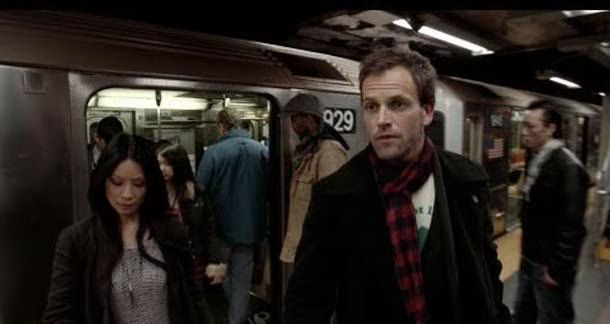
Yeah, Watson is female. But I'm going to reserve judgment until I've seen a few more episodes. On the surface, it comes across as a barely-disguised piece of stunt casting, a ploy to draw on a "Will they?/Won't they?" dynamic that's been used to great effect in series like Bones and The X Files. But that doesn't seem to be the sort of relationship we're getting here, and that's a great relief, since Miller and Liu have a frustrated brother/sister chemistry that serves the show well. Liu is tasked, as the sober companion to the recovering addict Holmes, with making sure he stays that way at the behest of Holmes' distant father, who is allowing his son to stay in one of four vacant properties he owns in New York under the condition that he keeps his nose clean. Holmes, meanwhile, serves as a consultant to the NYPD under Police Captain Tobias Gregson (Aidan Quinn). Our first case-of-the-week involves a psychiatrist whose wife is found dead in a hitherto undiscovered panic room in the couple's posh New York home.

Right from the get-go, there's a real sense of levity here that's refreshing. Holmes is troubled, but he's not troubled all the time, and his playful dealings with Watson feel like a natural extension of his tweaked-out character. He's tatted-up, sports a mean six-pack, and keeps his senses sharp by watching a bunch of programs on ten different screens at once. But even with all the quirks, Miller still does an excellent job connecting with the Holmes lineage. You can see the gears moving in his head, working out the puzzles even while he's in the middle of one of his famous "parlour room" speeches (in which he lays out the identity of the killer, how they did it, and why). The culprit's plan is very circuitous, relying upon playing into a serial killer's existing predilection toward petite redheads, and doping him up with steroids to trigger his barely-contained killer instinct. It's a case he wouldn't have been able to solve but for the presence of Watson, who discovered a link between the serial killer's rice allergy and the disappearance of his cell phone (just roll with it), culminating in the culprit's arrest. It's a unique case told well, packed with enough twists on the formula to keep ahead of the viewer, but the case itself is ancillary to the darker stories which have only been hinted at in the premiere.
Credit: CBS
Holmes deduces, with supernatural accuracy, that Watson was once a surgeon, but either resigned or was dismissed due to a mistake on the operating table that cost a man his life. For her part, Watson deduces that Holmes has deeper issues than he's leading on, owing to a spot of bother over a woman back home, theorizing that it's difficult for him to let people in, while also noticing that he has no mirrors in his house because he "knows a lost cause when [he] sees one." Lucy Liu certainly does a lot with the character while playing the role through such a small window: she doesn't get broad the way Miller does, and so her Watson provides an effective contrast to the skittish explosiveness of Holmes. It's a dynamic pairing that doesn't immediately scream "Sherlock Holmes and Dr. Watson."

In fact, there's almost nothing to suggest this is actually a Sherlock Holmes adaptation other than the names of the two leads. There's no indication that any Moriarty or Mycroft is forthcoming, nor is the case itself a twisty adaptation of an existing Arthur Conan Doyle work, and even the press releases about the series seem to refute the notion that we're headed in that direction. If they plan on introducing any of these elements later, then de-emphasizing the Holmesian (might not actually be a word) elements of the series is a smart tactic to take. Let the show stand on its own two feet in the early going, establishing itself as a strong procedural drama, before introducing any of the overarching elements of the canon. This is clearly a show that benefits from not hewing to a mythology or broader narrative than the case-of-the-week would demand. The character stories are larger, sure, and that's exciting, but the plot itself is relatively self-contained, which is part of why the pilot works as well as it does.
Some people love forensically-oriented procedurals, which can be pretty damn exciting when done well, but Elementary subsists on a diet of more routine, by-the-book, door-to-door detective work. Almost nothing that is used to solve the case is anything that isn't apparent through deduction or, as in the case of the bag of rice in the climax, is visible in plain sight. It's an interesting tact to take in storytelling, a Mentalist without the "Red John" arc, although there's more going on in the pasts of both Holmes and Watson than we're being told. It should be fascinating to see those details come to light over the course of the season, particularly within the context of each investigation. And if they do introduce elements of the Holmes canon? All the better, since I imagine this is as close to a sure-thing as CBS has got among its slate of new fall shows. I guess we'll have to wait and see how the ratings come in. As for now, the series premiere is a pretty easy thumbs up.