Elementary - Season 1 Episode 3 - Recap and Review - Child Predator
Elementary offers up a pretty great episode with "Child Predator," an exciting hour that sets aside some of the serial elements of the show in service to a tightly-focused story. The premise is somewhat fantastical, on its face, with a villain that seems straight out of an airport thriller novel. Yes, it's Sherlock Holmes vs. The Balloon Man, a serial killer who abducts children, leaving behind balloons as his calling card. Holmes (Jonny Lee Miller) is on the case with the help of Dr. Joan Watson (Lucy Liu), whom Holmes claims to use as a sounding board for his thoughts and ideas as he works out the details of each case into a workable M.O. But Watson proves to be more than just the "white noise" in the background for Holmes, as she offers several key insights that cause Holmes to rethink certain discrepancies in the investigation. Holmes and Watson's chemistry is more pronounced here than in episodes past, adopting a sort of jocular combativeness with one another that's refreshing in a procedural this manic. Coupling the increasingly comfortable dynamic with a compelling case makes this easily the strongest episode of the series thus far.
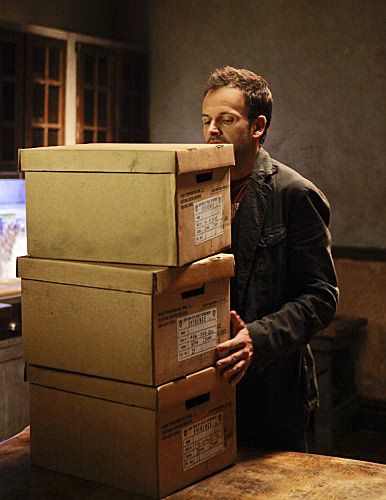
Young Adam Kemper was abducted by the Balloon Man at age 12, and his victimization leads to a schism in his psyche that provides a fitting contrast with the manic processes of Holmes. Now age 19, Kemper (Johnny Simmons) is a witness in the investigation into the Balloon Man, who is revealed to be Samuel Abbott (Christopher Evan Welch), a man recovering from a recent back injury. The case is a ticking clock affair, with Holmes racing against time to piece together the Balloon Man's identity and whereabouts before he kills his latest kidnapping victim. Immediately, Jonny Lee Miller is shown to really excel at playing a Holmes who's under the gun. Holmes has never been a subdued character on this show, but even in his most supercharged moments, he's never seemed as on-point as he has tonight. I know that it's mostly the writing, which is uniformly strong for a procedural, but Miller really does bring a sense of crazed function to the role that imbues Holmes with a different kind of force than he's had in previous incarnations across various media. He's a very current detective surrogate, perhaps because he's not actually a detective, and his methods tend to act outside the realm of evidenciary procedure (more often than not, Holmes goes on intuition, which then leads him to evidence he can use). This process helps distinguish Elementary from your more rank-and-file procedurals.
Credit: Giovanni Rufino/CBS
What's most interesting about this episode, however, is its lack of any subplots or narrative threads external to the primary case. No more of Joan's boyfriend or the sobriety meetings, and only glancing references to Holmes' father and Joan's past as a surgeon. It seems that Elementary is either attempting to tone down or avoid overt serialization, instead opting to tell stories in which character is learned through action. We learn as much about Holmes in this case as we learn from the perp of the week. For instance, how much of Holmes' story about his childhood boarding school days is true? He admits that he did, in fact, attend boarding school as a youth, but he doesn't let on about much else concerning his story of childhood trauma. To that end, Holmes attempts to remain unknowable, in much the same way the Balloon Man attempts to obfuscate his true identity. In a truly great reveal, the actual Balloon Man is Adam Kemper, who took over the role from his captor, both traumatized and galvanized by the experience of his abduction. In a genius stroke, he's managed to obtain immunity for himself for all crimes committed in consort with the Balloon Man. He's essentially untouchable. However, Watson's observation about the late Samuel Abbott's back injury (Abbott had been killed by police to prevent him from shooting an abducted girl) leads Holmes to realize that Kemper had to have committed at least one of the murders on his own, without any help from the original Balloon Man. With this revelation, the police move in for the arrest, with Kemper insisting he won't be in prison long. Of course, this ignores what happens to child killers in prison.
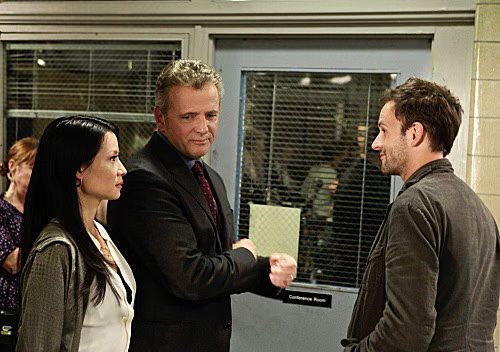
"Child Predator" succeeds by keeping the narrative focused on the case at hand, which means it's a much sparser episode than most, in terms of sheer content. It mostly just boils down to the Balloon Man investigation. That said, I do wish they'd do more with some of the ancillary characters in the cast, like Captain Toby Gregson (Aidan Quinn) and Detective Marcus Bell (John Michael Hill). It's not that they're compelling characters in their own right, it's simply that it feels as though there's a show of greater import beneath the endless back-and-forth between Holmes and Watson, and the Russell Crow-does-John Nash-esque computational skills of Holmes. Beyond that, however, it's also that Aidan Quinn is too substantial a talent to be as marginalized in the series as he is. It's kind of a shame, really. That said, we're only three episodes in, so I can't imagine they won't use him in a more substantial way, going forward. But I'd certainly like to see a semblance of the rapport between the two men, even if it's as combative as the rapport between Holmes and Watson. Even in his brief moment, reprimanding Holmes and reminding him that he's not actually a cop, Quinn displays a commanding screen presence. In a different show, he'd have made a fine Watson, offsetting the quirks of Holmes by leavening his sense of reckless genius with the occasional "come to Earth" slap-around.

As it stands now, I'm beginning to wonder if the series isn't perhaps setting Holmes up for a relapse. There was much made of the fact that Holmes is starting to live a healthier lifestyle, training with Joan and strengthening his core, to say nothing of his continued sobriety. This felt more like foreshadowing than a mere statement of progress, particularly because of the six-week limit on Joan's partnership with Holmes. The creative forces behind the series will eventually have to find a way to keep Joan from leaving once the six weeks are up, and having Holmes fall off the wagon would be the easiest way to do it. However, assuming that's the role they take, they're going to need to take the next several episodes really developing Holmes' character and building relationships whose destruction or compromise could drive him over the edge. Who knows, perhaps it's his friendship with Watson or Gregson going south that drives him back to using drugs? Either way, I feel as though there's a compelling arc there with Holmes, in which the effects of substance abuse on a unique mind can be illustrated. There's a wonderful sense of damage about Holmes across the generations, whether in Arthur Conan Doyle's novels or Benedict Cumberbatch's wonderful portrayal in recent years, and it's here too in Jonny Lee Miller's Holmes. I certainly hope he gets the chance to elaborate upon that damage and show us the meat of the character beneath.