Doctor Who - Series 7 Episode 3 - Video Recap and Review - A Town Called Mercy
"We all carry our prisons with us."
It's a pretty succinct summation of the many ideological crises of Doctor Who, and it comes from the mouth of this week's ostensible villain, an alien war criminal who is attempting to justify his acts to The Doctor while implicitly acknowledging his wrong-doing. "A Town Called Mercy" is, thematically, the richest episode of series 7 so far, for how it brings the moral and ethical implications of The Doctor's travels to the fore.
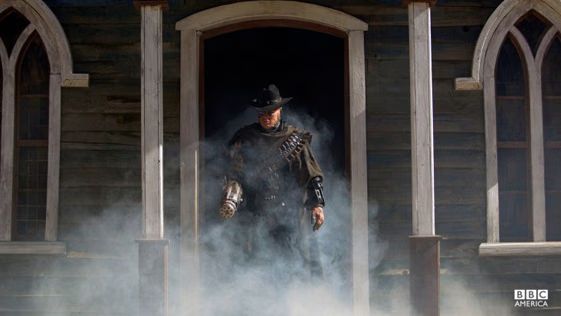
En route to Mexico for the annual Day of the Dead festival, The Doctor (Matt Smith), Amy (Karen Gillan), and Rory (Arthur Darvill), find themselves stranded in a town called Mercy, a sleepy little town with 81 residents and an anachronistic supply of electricity. There's a border around the town preventing anyone from entering or leaving. It's not an invisible border, however, but instead a border enforced by a mysterious being known only as The Gunslinger (Andrew Brooke), a cyborg with a vendetta against the "Doctor." Upon revealing his name to the barkeep, the townsfolk revolt against The Doctor, believing him to be the alien doctor The Gunslinger has been hunting since his curious arrival three weeks prior. The townsfolk keep their guns trained on The Doctor to prevent him from coming back into town, but the intervention of Sheriff Isaac, who states that The Doctor is not the "doctor" The Gunslinger is after, begins the process of unraveling the mystery behind Mercy.
As it turns out, Isaac has been harboring another alien doctor, a man named Jex (Adrian Scarborough), of the brilliant Kahler race. He crashed in Mercy en route to his home planet, and, having decided he'd given all he could to the Kahler race, elected to stay. Dr. Kahler-Jex gave the town electricity, medicine, even going so far as to cure a plague of cholera. Yet, not everything is on the up-and-up. As we learn during The Doctor's risky gambit to bait The Gunslinger, Jex isn't a benevolent doctor at all. He's a war criminal. The Kahler race had been embroiled in an endless war and, in desperation, Dr. Jex took volunteers under the guise of special training, and repurposed them as cyborgs, designed to end the conflict. Though this plot was successful, ending the war in under a week, the decommissioned cyborgs revolted, hunting down all those responsible for their creation. The hunt left only one cyborg and one scientist: The Gunslinger and Dr. Jex.
"A Town Called Mercy" is breezy in places, but its dramatic heft is considerable, as there are plenty of subtle, thematic callbacks here for the discerning Whovian. For one, The Doctor's documented aversion to guns makes it all the more jarring to see him draw a six-shooter and pull back the hammer, teetering on the edge of his own moral ruin. Sure, it's not like we haven't seen him wield a gun before at various points over the past ten incarnations, but we haven't seen him come this close to killing in cold blood since The Tenth Doctor held a gun to the head of the man who'd killed his "daughter". The difference? The Tenth Doctor handed the gun back to the man and explained that, when given a chance to pull the trigger and take vengeance, "I never would." Here, when Amy asks if The Doctor would really shoot Dr. Jex, The Doctor states that he doesn't know for certain. This frightening change towards vigilantism is brought about by Dr. Jex's callous accusations that The Doctor lacked the nerve to do what must be done. Of course, The Doctor has pretty much made a life out of doing what must be done, particularly in regards to the Time War between the Daleks and his fellow Time Lords. In this sense, it's understandable that this accusation of cowardice would be his berserk button, sending him into an uncharacteristically wild fit. Smith does terrific work with the change, making it jarring in the short-term, but completely believable as an arc for his character. Even three seasons in, the man continues to impress me in the role. Just a staggeringly good Doctor.
Naturally, the fact that The Doctor came so close to pulling the trigger scares Amy. "This is what happens when you travel alone for too long." Without companions, The Doctor could become reckless with his power (for evidence of the kind of "god run amok" a companion-free Doctor could become, look no further than the "Time Lord triumphant" of 2009's "The Waters of Mars," one of David Tennant's final appearances as The Doctor). This first half of series 7 has protracted, and enriched, the story of why The Doctor needs companions, if not these particular companions, in Amy and Rory. They balance him out and allow him to see the futility of violence. "Violence doesn't end violence," he tells a scared, gunslinging teenager, "it extends it." And it's something that we can easily believe The Doctor has always believed, even if he does have the occasional lapse in judgment. The Doctor has always been moral, but he needs people like Amy to dutifully remind him that he has to be better than his enemies, even if that means being merciful to beings whose atrocities should condemn them to a nightmarish end. "You're both good men," Sheriff Isaac says of The Doctor and Jex, "You just forget sometimes." And Amy is there to remind him, not just of the need to rise above his own occasional bloodlusts, but also that people can change, that they're capable of redemption. It's a theme of any good western, and it's front-and-center here.
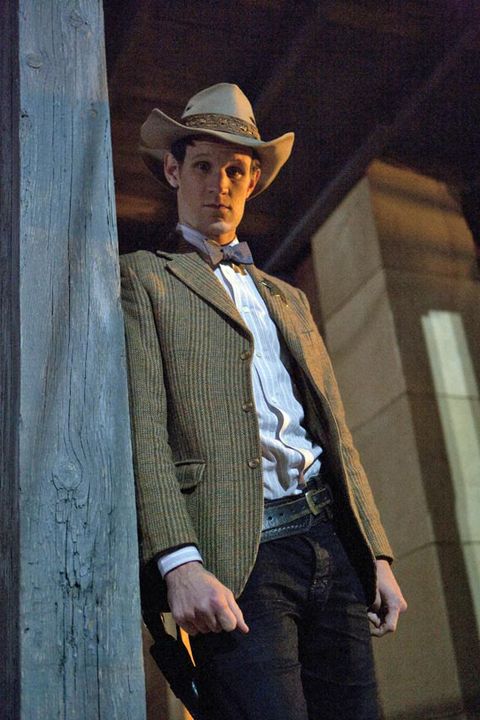
But that isn't meant to undersell how whimsically adventurous "A Town Called Mercy" happens to be. The Doctor names Amy his deputy after being made Marshall of Mercy by the dying Sheriff Isaac (accidentally gunned down by The Gunslinger). Thus, The Doctor begins concocting a scheme to save Mercy without anyone getting killed, a plan that climaxes with a duel at high noon between The Gunslinger's cyborg arm cannon and The Doctor's sonic screwdriver. It's not exactly a visceral climax, but it's a lot of fun, with The Doctor serving as a decoy-Jex, along with several other townspeople, in a bid to give the real Jex time to escape to his ship, moving this conflict away from Mercy entirely. Ultimately, tying into the redemptive arc of the episode, Jex chooses to trigger his ship's self-destruct mechanism to free The Gunslinger of his desire for vengeance, and also to unburden his own soul. Kahler dogma states that when a Kahler dies, their spirit must climb a mountain bearing the weight of all the souls they've wronged in life. "Perhaps they'll be kind," Jex muses before the end.
It's a frequent theme of Doctor Who that forgiveness and redemption are principles which all beings, in one galaxy or another, should be capable of embracing. The Gunslinger, for his part, finds his redemption in choosing to protect the people of Mercy, going forward. The visual of the cyborg overlooking his new home from the cliffs, in my opinion, is a powerful visual that communicated the ability to rise above vengeance and self-interest far more directly than just about any line in the episode.
But really, for as well-written as "A Town Called Mercy" was," it was infinitely more gorgeous to look at. Maybe I'm just a sucker for the Old West, but the broad, sweeping scope of the rocky plains, and the glint of the sun over the dust gets me every time. The visuals reminded me of some of the finer modern westerns put on film, such as The Proposition or The Assassination of Jesse James by the Coward Robert Ford. The setting also complements the lighter moments of the episode well, as The Doctor is funnier here than I can remember him being for most of last season (which felt like it was all business, all the time, enjoyable though it was). His offense at the idea of The Gunslinger purposefully harming hats is worth the price of admission alone (God forbid he'd shot a hole through a fez and not a Stetson), nearly matched by his back-and-forth with his horse, Susan, a mare trapped in a stallion's body. We should all be so accepting of a horse's life choices.
"A Town Called Mercy" is among the better one-off adventures of the past season, with callbacks to The Doctor's past and implications for his future. It looks like the Ponds are rethinking their companion status with each trip, while The Doctor grows increasingly savage in his dealings with enemies (he let Solomon burn last week, not that the space pirate didn't deserve it). This could lead to a very complex season-long narrative. The more complicated, the better. Doctor Who does complicated better than just about any show on television. Hopefully, no more hats have to get shot, or I fear both of The Doctor's hearts will break.