Doctor Who - Series 7 Episode 4 - Recap Video and Review - The Power of Three
Never has an invading force seemed so arbitrary to a Doctor Who story, yet the black cubes of "The Power of Three" seem small potatoes compared to the weightier story of the mutual inability of The Doctor and the Ponds to come to terms with the inevitability of their separation. It's a beautiful story, setting up next week's mid-point finale, which should make for one of the most emotional departures in series history. In addition, we got a story rife with callbacks for the classic Who nostalgic, set against the backdrop of "The Year of the Slow Invasion," the year in which The Doctor (Matt Smith) became a part of the Ponds' way of living, instead of the other way around.

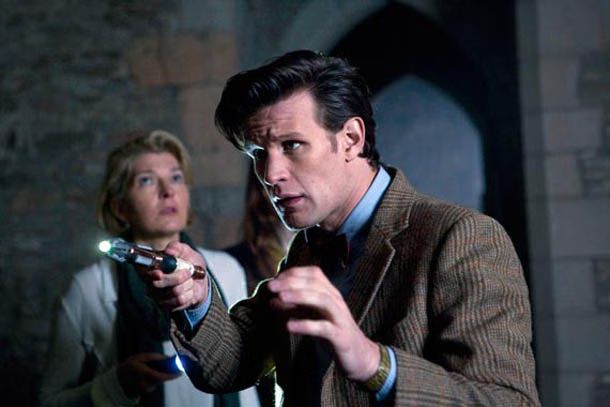
Millions of identical, indestructible black cubes have appeared all over the world, and though they initially present an unspoken menace (terrifying everyone by the obscurity of their purpose), the cubes are eventually integrated into society. From "silent menace" to "cute stray dog you want to bring home," the cubes start getting used as paperweights, napkin holders, even as obstacles for office golf. As The Doctor waits around with the Ponds for the cubes to start doing something, along with Rory's returning dad, Brian (Mark Williams), we're introduced to Kate Stewart, the new head of UNIT. The Unified Intelligence Taskforce is hardly the only Earth-defense organization with which The Doctor has dealt over the course of the series, but it is the most identifiable, owing to his close friendship with Brigadier Lethbridge-Stewart, a favorite among longtime fans of the series. Nicholas Courtney passed away last year, and a mention of the Brigadier's death was written into last year's "The Wedding of River Song," in an emotional moment. If that was enough to bring a tear to the eye of longtime Who fans, then this episode's reintroduction of the Brigadier's daughter, Kate, is enough to get a person feeling all warm and fuzzy all over again. For as brief as her role might seem, Jemma Redgrave is wonderful as the Brigadier's daughter, communicating the warmth of her father's regard for The Doctor, and immediately calling to mind any number of Doctor/Brigadier adventures over the years.
As for the threat the team is facing, it's revealed that the black cubes are, essentially, interstellar slug pellets, attacking humans by sending them into sudden cardiac arrest, having learned the humans' heart-based weakness from a year of patient observation. The plan, designed by the fabled Shakri, whom The Doctor had always assumed were a piece of Gallifreyan lore and nothing else, is audacious in scope. And it almost works, but for The Doctor infiltrating the Shakri spaceship with Rory and Amy, and sending out a mass defibrillation signal across the Earth, reviving the third of Earth's population that had already been felled by the black cubes.
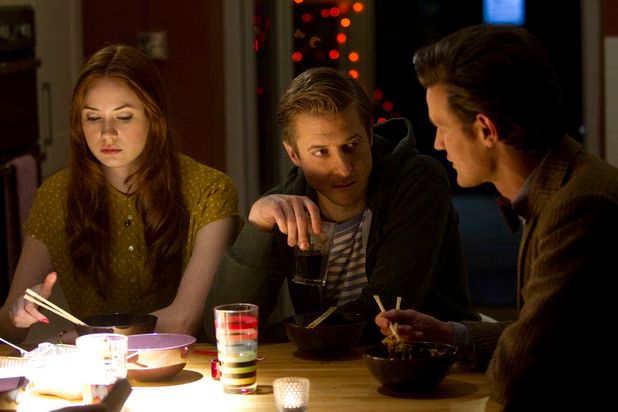
But "The Power of Three" isn't a big, spanning narrative so much as a smaller, character-focused tale. Rory (Arthur Darvill) and Amy (Karen Gillan) are getting used to normal life, away from The Doctor, and they're finding that they actually enjoy the hubbub, and making long-term commitments (Amy as a bridesmaid, and Rory as a full-time nurse). The Doctor's reappearance, however, seems to cause the Ponds to question whether this is something they really want to still be doing with their lives, as they're seen as unreliable by friends and colleagues, due to disappearing for months at a time, with no explanation, whenever The Doctor comes around. It even happens at Amy and Rory's anniversary party, where The Doctor pops in to give them their gift, a night at the Savoy Hotel circa 1890, only to get sidetracked for seven weeks when an alien spaceship happens to be beneath the building, somehow culminating in the trio being on the lamb from Henry VIII after Amy inadvertently accepts his marriage proposal. It's that kind of episode.
Of course, this only takes but a few minutes, but the point is made: The Doctor's way of living is inherently unpredictable, and the Ponds don't really need that in their lives right now, even if their fondness for the Raggedy Man himself is enough to get them to give him another shot. The Doctor, for his part, is beginning to understand what his way of life does to people. When confronted by Brian, The Doctor explains that some companions have left him, others he's left behind, while some, a very unfortunate few, have died (I guess Adric still weighs on his soul, though I'd argue a majority of the companion deaths weren't his fault. Maybe Katarina was, but Sara Kingdom was never long for this world. Also, please ignore my nerdery, it's a process I must be left to work out). The Doctor explains that he won't ever let that happen to Amy and Rory. "Not them, Brian. Never them."
This moment of grim severity from Matt Smith is topped only by his moment outside the Tower of London with Amy. She explains that she doesn't know if she and Rory are sticking around for much longer, adding that she feels he's always running away. He responds that he doesn't run away from things, he runs to them, before they fade away.
"Then why do you keep coming back for us?"
"Because you were the first. The first face this face saw. And you're sealed onto my hearts," he says, adding, "I'm running to you and Rory before you fade from me."
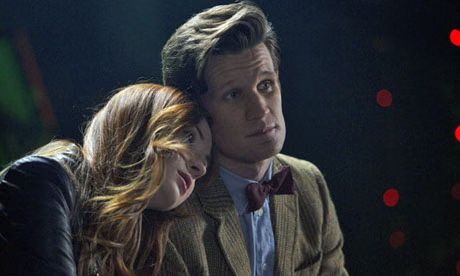
It's the Eleventh Doctor's most nakedly emotional moment, writ large in the grand scheme of this first half of series 7. It's a moment that resonates in a huge way, precisely because it comes so rarely from Eleven. That's not to say that he isn't sentimental, or that he doesn't have moments that affect, but simply that he's a more guarded Doctor than our last, more reserved about the display of his deeper feelings, beyond the giddy, child-like fondness he displays for the Ponds. I don't think he's ever been as close to tears as he was here, and I can't say that about the perpetually near-waterworks Tenth Doctor. There's always been that question in Who fandom: "Who's your Doctor?" Because it doesn't matter when you start watching, or who your first Doctor was. There comes a point where you come to realize that this actor, doing this portrayal, is your Doctor. The one with whom you most identify, and the one whom you most identify with the role. Matt Smith is coming perilously close to supplanting Tom Baker as my Doctor, and episodes like these are precisely why. Never mind the silly dance he does in the hospital after Amy defibrillates his second heart, which is an exceptional moment in itself. It's the intimate moments like these, or even the moments of steely resolve, as when The Doctor gets in a cube's face and states, "This planet, these people are precious to me, and I will defend them until my last breath." It might be bordering on a Big Damn Hero moment, but it works, because The Doctor might not be from Earth, but his fondness for the planet and its inhabitants is a long-established facet of his character, stretching back to the Hartnell years when it was only just developing from condescending snobbery.
Adding more to the emotional cache of the hour, we learn that it's been ten years since Amy and The Doctor's first adventure together. In that time, Amy and Rory fell in love, Rory died (several times, to an almost comic degree) and then waited nearly 2000 years to see Amy again, and then they gave birth to a daughter, whom The Doctor later married, and countless serial adventures in between. As The Girl Who Waited and her Raggedy Man sit outside The Tower of London, it's hard not to feel wistful about their partnership. There's just something so natural about the two that it's disheartening to know it comes to an end next week. Really, there's no better way to get that process started than an episode like "The Power of Three," which affirms The Doctor's strictures on maintaining companions while simultaneously preparing us for the departure of two of his best.