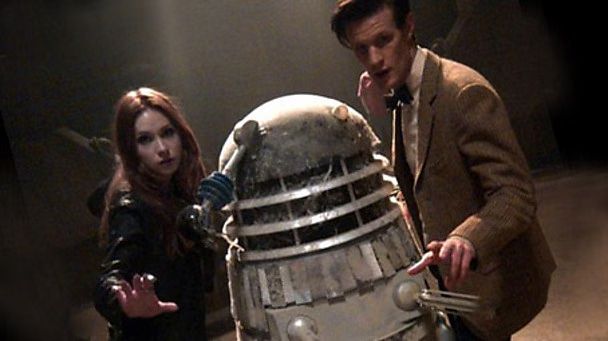
Doctor Who - Season Premiere - Video Recap and Review - Asylum of the Daleks
After a year on the shelf, Doctor Who returns with "Asylum of the Daleks," and immediately recalls just the fantastical fancy television is capable of achieving in the modern era.
Television has gone through something of a renaissance in the past five years. As recently as twenty years ago, you'd be hard-pressed to fine as much variety on the small screen as you do today, much less variety of this quality. There is literally not one genre on TV today for which you couldn't find a truly excellent program, from period dramas (Downton Abbey, Boardwalk Empire) to high-fantasy (True Blood, Game of Thrones, Being Human) to tightly-wound revenge narratives (Revenge, naturally). This is to say nothing of the modern comedy, where shows like Community, It's Always Sunny in Philadelphia, Parks and Recreation, and Louis provide completely different takes on what a comedy show can be. Even fairy tales have their place on the modern televised landscape, with shows like Once Upon A Time, Grimm, and The CW's upcoming Beauty and the Beast reboot filling the niche. Essentially, we live in an age where TV provides an embarrassment of riches for the discerning viewer.
And yet, good sci-fi has always been hard to come by.
Battlestar Galactica came closest to fulfilling that promise over its four seasons, and Firefly gave it a hell of a go in its brief run, but mostly, good science fiction is a relatively obscure thing to find on TV, since such shows tend to get canceled (on major networks) or marginalized to difficult timeslots (everywhere else) to wither and die.
Thankfully, this isn't the case with Doctor Who. While you might argue that 9pm on a Saturday night isn't the best timeslot in the world, Doctor Who is an institution, existing in some form or fashion for roughly forty years now. We've been through ten regenerations, companions into the double digits, and episodes into the triples. In brief, in a televised landscape where good science fiction is increasingly difficult to come by, Doctor Who remains one of television's most welcome stalwarts, and episodes like "Asylum of the Daleks" is precisely why.
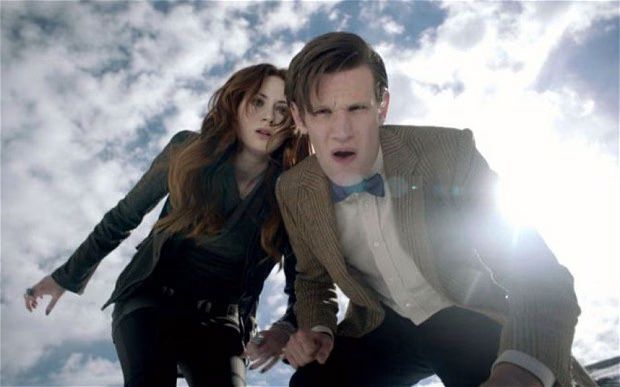
If you watched the web miniseries prequel Pond Life, you'll know that Rory (Arthur Darvill) and Amy (Karen Gillan) haven't seen The Doctor (Matt Smith) in quite a while, as he's been off adventuring and leaving behind Oods to sit on their toilet (just...watch the prequel, it'll make sense, I promise). Unfortunately, however, Rory and Amy's marriage is essentially at an end, their marriage dissolving over an undisclosed issue. We see Rory packing up and leaving, with Amy shouting after him, tears streaking her face, and this is our setup for the Ponds' return in the series 7 premiere.
I'll admit, when we first see the Ponds in "Asylum of the Daleks," and Rory is stopping by model Amy's photoshoot to get her signature on their divorce papers, the entire storyline felt singularly ludicrous. Seven hells, man, this is AMY and RORY! It absolutely beggars the imagination that a guy who waited 2000 years, guarding the Pandorica that contained the cryogenically suspended body of the woman he's loved all his life, would give up on her for ANY reason. So imagine my surprise when we find out it's Amy who sent Rory away. But we'll get to why, in a moment.
The main arc of "Asylum of the Daleks" is the return of The Doctor's greatest enemies (and one which the Eleventh Doctor hasn't had the opportunity to encounter that often over the course of his exceptional run - at least not nearly as often as the Tenth, who seemed to meet them every other week for a game of bridge). The Daleks have always been a fascinating race of alleged warriors. The brainchild of the genius Kaled scientist Davros, the Daleks (named as an anagram of "Kaled") were confined to their pepperpot-shaped shells as the result of an internecine nuclear war against the Thal race on their home planet of Skaros. Though The Doctor isn't responsible for what confined them to their shells, he is, however, responsible for the near-total annihilation of the species during The Time War. So their hatred of The Doctor is understandable - every bit as understandable as his own mistrust of them.
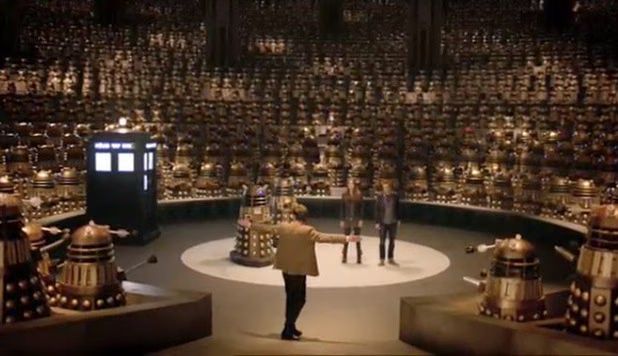
This makes it all the stranger when The Doctor receives a distress call from Skaros, requesting aid. Few people know how to directly contact The Doctor, so he's immediately suspicious of the red-haired woman who claims she's escaped from a Dalek prison camp, and needs The Doctor's help to rescue her daughter, Hanna. This is suspicious because, you see, no one really escapes from Dalek prison camps. It's just not how they roll (pun intended, because really now...). As it so happens, The Doctor turns out to be correct, and the woman reveals a Dalek eye-stalk protruding from her forehead, which fires and renders our good Doctor unconscious. The Doctor, along with the captured Rory and Amy, is brought before an entire host of Daleks in their parliamentary headquarters, where the Prime Minister (outside of his shell, showing the husk of a people the once-mighty Kaleds have become) makes his request of The Doctor, on behalf of the Daleks: "Save us."
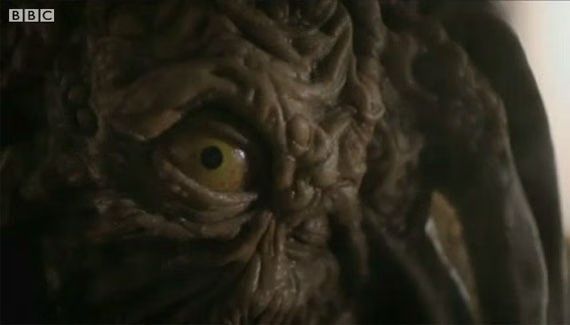
As it turns out, the Daleks have set aside an entire planet to serve as the asylum for the crippled, crazed, and otherwise defective Daleks. An unidentified ship has crashed on the planet, opening a gap for these deranged (well, more so than usual) Daleks to escape and wreak havoc on the entire race. The Doctor's mission, go down to the planet and find a way to disable the impenetrable force field surrounding the planet, so that the Daleks can then neutralize the threat by destroying the planet altogether.
With little choice but to accept, The Doctor beams down with Amy and Rory, where they meet a survivor whom they quickly learn is no survivor at all, but a corpse appropriated by the Daleks to serve as a security force for the planet. Anyone without a bracelet frequency jammer runs the risk of being turned into a shell to be used by the Daleks, much like Hanna's mother. Their memories are slowly exterminated (again, pun intended, because come on...), and replaced by the genocidal ideology of the Daleks.
Thankfully for The Doctor and crew, they're being aided by a shipwrecked computer genius named Oswin Oswald (Jenna-Louise Coleman), who's capable of hacking into the Daleks' complicated systems and has staved off their threat for over a year. In the meantime, she listens to classical music while keeping an audio diary for her mother, and making terrible souffles, which sends The Doctor into an amusing fit of confusion over where she could possibly have gotten milk and eggs from. She's a great addition, if a bit of a retread, as Coleman is equal parts smarts and spunk, but it still works. She also possesses a healthy, yet not-at-all terminal, level of quirk, such as when she flirts with Rory (calling him "Nina") or quotes legendary film actress Mae West ("Come up and see me sometime!"). Her presence in the early stages of the episode provides an effective contrast to the severity of the circumstances, keeping that light, adventurous atmosphere, even as their situation starts to go pear-shaped.

As the team avoids the Dalek husks and finds their way into the asylum proper, we see just exactly the level of ruin they're dealing with: these "broken" Daleks are slow, and some of their equipment doesn't work like it should, but they're even more singularly focused than their brethren, simply seeking to exterminate, but without the battle acumen or general intelligence of the standard Dalek. They're essentially devoid of inhibition, of any limiting influence. They're more reckless and dangerous than The Doctor seems prepared to face.
Well, until he kills them all. In a clever gambit, he baits a dysfunctional Dalek into activating its own self-destruct sequence, then uses the sonic screwdriver to send it barreling reverse, right into a crowd of other homicidal Daleks, blowing up the lot of them. It's exactly what The Doctor does best, laying a beatdown without so much as curling a fist, and Matt Smith continues to exude bravado, undercut with clashing elements of tenderness and menace. He does it with such grace that all these factors are convincingly a part of the same character.
Oswin wants out, and so The Doctor resolves to find and rescue her. Unfortunately, Amy's lost her bracelet to one of the Dalek slaves and is slowly being turned into one herself. This provides The Doctor an opportunity to help Rory and Amy get back together by leaving them to their own devices, to sort out whatever it was that happened between them (and also giving Amy his bracelet because he's a Time Lord and doesn't need one, of course). Earlier, Amy insisted that there was nothing The Doctor could do to save the marriage, insisting that it's just life, "that thing that goes on when you're not there." Rory insists that Amy take his bracelet, saying that it'll take longer for the Daleks to turn him, since the process involves slowly killing off the love a person feels, and since Rory obviously loves Amy more than she ever loved him...
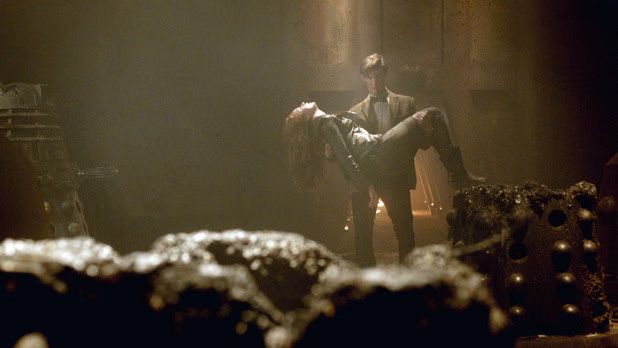
Aaaand slap. Amy is offended at the notion that Rory somehow loves her more than she loved him, as she reveals that the reason their marriage dissolved is because of Amy's guilt over not being able to give Rory children. Whatever Madame Kovarian and The Silence did to her last season, it's left her sterile, and now she'll never be able to give a child to the man who's always wanted to be a father. And so she let him go. It's a poignant moment between the two, leading up the Big Damn Kiss towards the end of the episode. Karen Gillan and Arthur Darvill have such insane chemistry together that I'm glad this plot was resolved here. I feared they would make this an extended "will they?/won't they?" arc between the two, and that just wouldn't work at all, because of course they will - they're Amy and Rory, for crying out loud.
So we make it to the big climax of the episode, as The Doctor makes it to Oswin's fortified lodgings. The Daleks close in on The Doctor, and Oswin comes to the rescue by deleting all of the crazed Daleks' information on The Doctor, rendering them harmless. Oswin, in her red dress and high-top sneakers, is the model of the adorable geek genius. Almost too perfect, to say nothing of the appearance of milk and eggs for the badly-done souffles. And it turns out to be exactly as bad as The Doctor was expecting. Oswin's control room, with the classical music, the souffles, the too-adorable-by-half outfit: it's all a dream, a fictional construct she created in her mind to shield herself from the truth.

She's been fully-converted into a Dalek, confined to a white room, and wrapped in chains.
The Dalek race, suffering from a serious lack of straight-up geniuses, went whole-hog on the Dalek transformation with Oswin, confining her to a Dalek dome with Dalek voice and all. It's an immensely tragic scene that Matt Smith plays with two-heartbreak, essentially conveying the devastation on Oswin's behalf. Here is a person The Doctor cannot save, and we know how badly that messes him up, the terrible realization of his own shortcomings. He can't save everybody, but with Oswin, he can't even try. It's already too late. The best he can do is try to help her remember that she's still a human underneath the mobile prison they've placed her in.
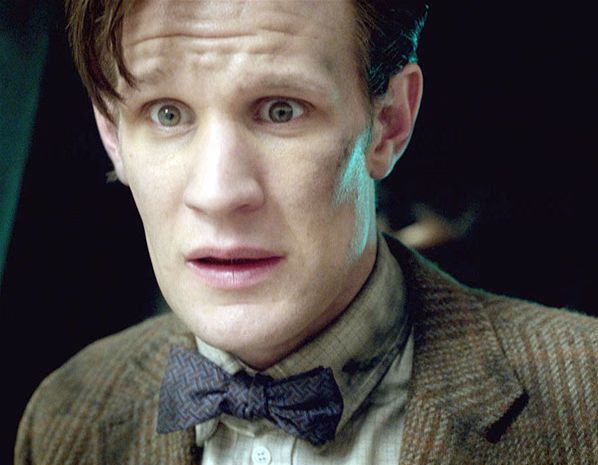
It's just enough to get her to free The Doctor and lift the shields surrounding the planet, pleading with The Doctor to remember her. There's something heartbreaking about a Dalek voice delivering sad lines, and it's fittingly dour here, especially when considering the person beneath the shell. As the Daleks destroy the planet from above, Oswin watches The Doctor escape: "Run, you clever boy. And remember."
And with that, the Doctor teleports directly back into the TARDIS (owing to his pinpoint accuracy with teleporters, which the Daleks really should be used to by now). As the Daleks begin chanting the one question ("Doctor who?"), The Doctor pops his head out of the TARDIS for one last bit of closing bravado: "Fellas, you're never going to stop asking."
"Asylum of the Daleks" is everything you could want in a Doctor Who premiere, full of equal parts bombast and intimacy, adventure and mystery. The episode also illustrated one of the key themes of the series in recent years; namely, the importance of companions in how The Doctor operates. Not unlike Robin to Batman, the companions not only assist The Doctor at a practical level, but their presence forces him to be more careful, since there are other lives at stake instead of just his own. Left to his own devices, The Doctor can be reckless, if not outright vicious (as in "The Waters of Mars"). The companions keep all that power from going to his head, and also ground him to reality, rooting him in the present despite the fact that The Doctor is not exactly beholden to time itself. In essence, they help to contextualize him, as well as his actions, so that he doesn't forget who he is, or what he stands for. This is the final season for the Ponds, and they've done as good a job as any companions The Doctor has ever had in helping distill his character into everything he can/should be.
There might not always be a wealth of good sci-fi on TV at any given moment, but as long as The Doctor is in, we'll never be left wanting.
Oh, and "Dinosaurs on a Spaceship" next week. Because yes. Just...yes.