Call the Midwife - Series Premiere - Video Recap and Review - Concussed, Nonplussed
In January of this year, BBC One premiered Call the Midwife, a series created by English screenwriter/playwright Heidi Thomas from the memoirs of the late Jennifer Worth, a midwife in East London in the late 1950s. The series was a considerable hit, becoming the most successful freshman drama series on BBC One since 2001. Its premiere, "Concussed, Nonplussed," debuted tonight, and it's hard to deny its appeal, offering a fact-based medical drama from a rare perspective. Capitalizing on the stateside infatuation with British period drama Downton Abbey, PBS hopes to replicate that success by bringing this series to US audiences. While the premiere doesn't give the indication that series will have the soap operatic appeal of Downton, the show is still a remarkable production, made all the more remarkable for being based on a true story.
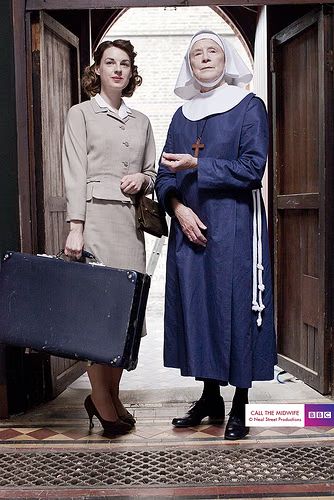
Jenny Lee (Jessica Raine) could have been an air hostess, a model; she could have moved to Paris and become a concert pianist. At 22, the possibilities were as varied as they were endless. However, she ultimately chose to become a midwife, under the erroneous assumption that it would be easy. The madness of youth tends to work that way. Jenny is newly-certified, reporting to Nonnatus House, a nursing convent placing young midwives under the same roof as the nuns, themselves nurses and midwives. Though Jenny is initially thrown by the religious implications of service in a convent, Sister Julienne, the Sister-In-Charge at Nonnatus House, assures Jenny that no matter what each individual's religious inclination happens to be, they're nurses first, and midwives foremost. The convent itself is host to an array of vivid, distinct women, the kind of female cast an American show would love to have: the eccentric, cake-obsessed Sister Monica Joan (Judy Parfitt); the blunt, experienced Sister Evangelina (Pam Ferris); the elegant and charismatic Trixie (Helen George); the clever, cheerful Sister Bernadette (Laura Main); the gentle, reserved Cynthia (Bryony Hannah); and the aforementioned Sister Julienne (Jenny Agutter), who is warm and sensitive, but also judicious and pragmatic in her approach, to say nothing of her devout religious convictions. It's a wonderful ensemble, less in its individual parts and more in the cohesive unit it presents. The strength of its actors is certainly one of the show's best assets right out of the gate.
Credit: Neal Street Productions
The premiere follows Jenny's first few weeks as a midwife, dividing the episode across three patients: a young mother named Muriel who, alongside Sister Evangelina, Jenny helps to deliver a healthy child, despite excess soot being brought to bear down on the birthing room due to the clogged chimney. The experience marks Jenny's first encounter with the abject living conditions of East London, with children sleeping four to a bed, and Muriel lying on mattress with newspapers beneath the sheets, in order to keep her urine from seeping through and ruining the mattress. It's the classic "Yeah it's gross. Get over it!" scene of any drama in which a novice discovers that their new situation isn't going to be all sunshine and roses. Here, Sister Evangelina plays the role of the grizzled vet who's seen and done it all, crumpling up the urine-soaked newspaper like it's nothing at all. And, in the big picture of the life or death struggle of birthing a child, it isn't. The case orients the viewer in Jenny's new environment, but also serves to induct Jenny into the path she's chosen in life, the first step the premiere takes in developing her strength of character.
Credit: Neal Street Productions 2011
The second case involves a pregnant woman named Pearl, who's rough around the edges (brawling with another woman in the streets, in the opening moments of the episode), and who has several children already by her working-class husband. However, an unforeseen complication arises when Jenny discovers a cyst on the woman's vulva, what Sister Julienne diagnoses as a syphilitic chancre. Jenny has trouble coming to grips with her revulsion, scrubbing her hands furiously. "I didn't know people lived like this," Jenny cries. "But they do," Sister Julienne responds. "And it's why we're here." It's a harrowing narrative that doesn't sugarcoat the often-disgusting conditions in which the people of these narrow slums live. The story weaves into the third narrative, around which the bulk of the episode revolves.
Conchita Warren is pregnant with her 25th child, having given 24 children to her loving husband, painter/decorator Len Warren. Len doesn't speak a lick of Spanish, nor does Conchita know any English, but their love has flourished through a deeper level of communication, Len having brought Conchita home with him after fighting in the Spanish-American War. Conchita hardly looks like a woman whose given birth to 24 children, and, most incredibly, she's never lost a pregnancy. The scenes in the Warren household are the best in the episode, as Jenny continues her education in the poverty of the overworked and overpopulated. All the children gather around the cramped kitchen table, where Conchita sets down a pot of dumpling stew, encouraging everyone, Jenny included, to eat. Everyone grabs a spoon and dig in, eating out of the same pot. "There are no plates," Jenny observes, to which Conchita's eldest daughter says, "We never use them."
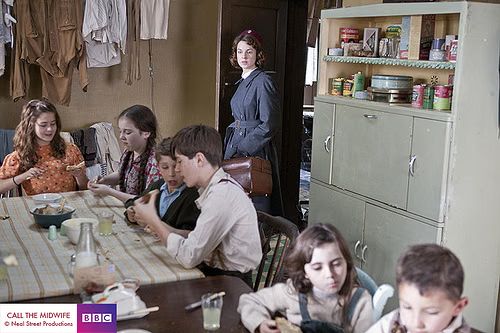
As the episode rolls on, Jenny comes to regard the Warrens highly for their resilience and love, and checks in on them frequently each day. Unfortunately, a burst of freezing smog engulfs London and, her vision obscured, Conchita falls. The resulting injury induces labor and, worse still, gives her a concussion, leaving her with only a vague, delirious sense of what's happening to her body. With the doctors and ambulance delayed or impeded, Jenny is the only person who can help Conchita, who is losing blood rapidly.
The tragedy of the events is matched only by the resolution, which puts the premiere over-the-top and firmly into winning territory. What might have been a simple tale of love and loss ventures into something grander, and though it comes across as a contrived invention, the fact-based nature of the events pulls the viewer in deeper, allowing them to suspend their disbelief just that much further. While the series initially appears to be about Jenny herself, finding her place in the world through the seamless continuum of life and death that midwifery represents, the premiere presents a more expansive narrative, offering glimpses into the class divide, and comments on the nature of poverty in a land given to excesses (though England is hardly America, in that regard, nor is the class differential nearly as high, I'd wager). Jenny learns exactly the strength of willpower and resolve it takes to be a mother at all, much less in the squalor of East London. When Jenny conquers her revulsion and comes to check in on Pearl, who's lost her pregnancy, Pearl suggests that Jenny "must think we're all slatterns out there."
"Actually," Jenny responds, "I think you're all heroines."
The classic showtune, "Stranger in Paradise," plays on the radio and transitions us into the closing sequence, in which we see that while Jenny is still a newcomer to this world, she's no longer naive to the facts of this life. She's begun the process of integration, eschewing her naivete for determination. This is a world in which she can affect real change, and now that she's seen what women are capable of, she adopts their steely resolve. Vanessa Redgrave provides voiceover narration for the series as the future Jenny, and through her we close on the overarching theme of life that permeates the episode: "I had begun to see what love could do. Love brought life into the world, and women to their knees. Love had the power to break odds, and to save. Love was like midwifery: the very stuff of life. And I was learning how to fly with it, through all the straits, like the river, to the sea."
"Concussed, Nonplussed" is an excellent premiere, though for more reasons than simply the very engaging story it tells. The filmmaking is superb, particularly the framing of shots in the streets and back alleys of East London, foregrounding a blonde toddler with his twin in the background, their yellow hair offering a stark contrast to the uniformly bleak, grey surroundings. Even simple shots like Jenny riding her bicycle past the local fruit vendor, who offers her some bananas, have a certain elegance to them. Jenny's bike-riding provides a lot of the stellar camera work on display here, with Jenny's ride through the fog with a police escort offering a uniquely Gothic visual, the two bicycles' lights piercing through the untenable darkness. I would also be remiss in not mentioning the montage roughly halfway through the episode, detailing Jenny's rounds in her first few days as a midwife, set to Doris Day's rendition of "Que Sera, Sera." It's a necessary moment of levity for the bleakness around the corner, and, indeed, for the bleakness that blankets the environment. The soot-blacks and gunmetal greys are oppressive in their constancy, yet the burst of sunshine in the episode's closing moments are an emblem of the indomitable spirit, and the ordinary miracle called life.
Watch Behind the Scenes - Working with Babies on PBS. See more from Call the Midwife.