Call the Midwife - Series 1 Episode 4 - Recap and Review - Baby Snatcher
We're past the halfway point in the first series of Call the Midwife, and it's disappointing, to me, that British TV seasons are so short, since episodes like tonight's "Baby Snatcher" make me wish I had a lot more of this show to look forward to in the future, beyond simply the two episodes we have left to go. It's a more overtly melodramatic episode than we've seen yet from the show, but beyond that, it's much more serialized than we're used to from the series. From week-to-week, Call the Midwife tends to operate as a medical drama, following "case of the week" strictures that focus more on the emotional, human element at its core than on the biology of it all, though that particular element is mined for all the drama it can produce. With this week's installment, the series takes a larger step towards serialization, and fleshing out its many disparate characters.
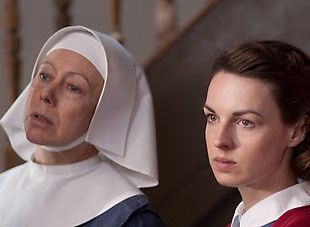
The titular kidnapping doesn't occur until roughly halfway through the episode, but you can almost feel something dreadful looming on the horizon, given the relative simplicity with which Shirley Redmond delivers her baby, Gillian, when contrasted with some of the more calamitous births this show has seen in its short life so far (even Shirley's previous birth, which apparently resulted in a stillbirth). Shirley is a sweet woman, and her husband is an honest, working-class bloke who's clearly adoring of his wife, as he comes racing up the steps upon hearing her pained cries during delivery. It's a sweet relationship, and the relatively dour setting of East London is offset by exuberant, ever-present sunshine, to the point that this feels almost like an entirely new setting altogether. The sudden transformation of the East End into an idyllic environment serves to lull the viewer into a false sense of security, and Shirley as well. She sets her baby just outside the door, in her carriage, so that she can take in a bit of fresh air. Only moments later, the husband returns, wondering where the baby is. To their mutual horror, their daughter has been kidnapped, and who else but our Jenny (Jessica Raine), having delivered baby Gillian, will take the case?
It's easily one of the most gripping stories the show has told thus far, and upon our first look at the perpetrator, a vague figure in the shadows trying to feed a caterwauling child, it's apparent who it is and why the child was taken in the first place. But the episode doesn't try to build this as a mystery. "Baby Snatcher" is equal parts thriller and tragedy: it's tragic in the sense of a mother's loss, that irreparable of all damages, with which no man could ever identify, having never delivered a child of their own body. The tragedy is twofold in that the kidnapping is merely an act of compensation from a confused, desperate, delirious child, with whom Jenny is well-acquainted. This aspect adds to the thriller elements of the episode, which is also exhilarating in that it presents a race against time, the entirety of East London searching for the child before she dies of malnourishment. The climactic standoff is great TV, with Jenny talking the culprit (I'm neglecting to reveal who the culprit is, just in case you're reading this without having watched the episode yet) into handing over the famished baby. Jenny has developed a lot as a protagonist, from pitying the townsfolk in their abject squalor, to being outright repulsed by it. But now Jenny sees that these are merely conditions of life, and conditions do not reflect on a person any more than the common cold reflects upon the quality of the sufferer. A mother's pain is a momentous thing, and Jenny has now been part of the cycle of life and death on both ends of the spectrum, bringing people into the world, and seeing them into the ground. That depth of experience has brought about a level of skill and maturity in her that had only been hinted at before now.
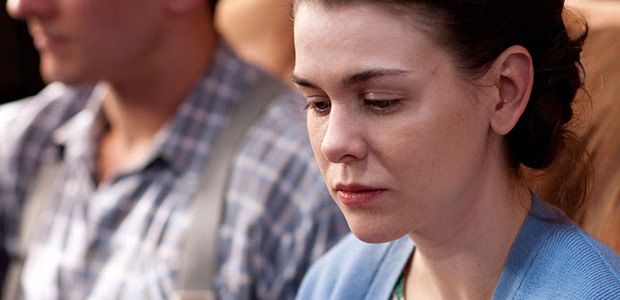
However, this is hardly the only storyline of merit in "Baby Snatcher." Cynthia (Bryony Hannah) learns firsthand the extent of love pit against death when she meets a schoolmaster named David, and his young musician wife, Margaret. They're rapturously in love, despite having only known each other for about a year, and having been married for six months of that time. These are two people in the throes of perpetual passion, undercut with a feeling of warmth that gives the relationship all the appearance of true love. In addition, the happy newlyweds are looking forward to the birth of their first child, with Margaret roughly halfway through her pregnancy. However, Margaret begins complaining about headaches, and it isn't long before the headaches blossom into an outright seizure, which is revealed to be the result of eclampsia, an off-shoot of toxemia, which is fatal far more often than not. Cynthia notices that David doesn't really seem to grasp the extent of his wife's condition. David still refers to his comatose wife in the present tense, wondering how he's going to break the news to her that she lost the baby.
Credit: Neal Street Productions
Cynthia has been something of a cypher thus far, in the sense that we don't really know who she is beyond the bookish, dutiful personality she presents. "Baby Snatcher" goes a long way in developing her longings and fears, and Bryony Hannah is great with what she's given here. In particular, she snaps at Trixie (Helen George) for scoffing at the idea of soulmates, a belief she shares with David (who refuses to let Margaret go, arguing that they are soulmates). It's a great episode for the character, culminating in her talk with David, in which she convinces him to allow her to cut off Margaret's wedding ring, a symbol of his refusal to allow her to die. Cynthia argues that some people need permission to die, and that they might linger on until the ones they love most, and who love them most, give them the okay to leave this world. With the ring cut off, David kisses Margaret's forehead, and it isn't very long before Margaret has died, and Cynthia is left to take in the full measure of witnessing a heart broken by death.
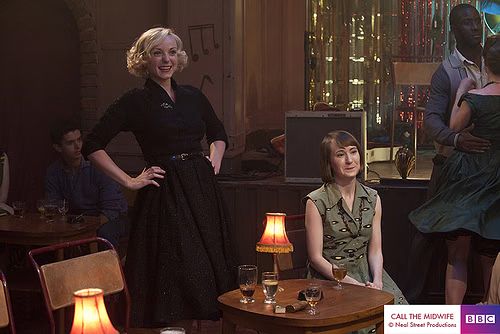
"Baby Snatcher" is the best episode of Call the Midwife thus far, and that's without even mentioning some of the lighter, character-building segments, such as the continued courtship between Chummy (Miranda Hart) and Constable Noakes (Ben Caplan), which leads to all the girls, plus Jimmy (George Rainsford), going to a dance and engaging in the first real bit of modern social fare we've seen on the show. Of particular note is a brief bit in which Trixie preps Chummy for her date, and teaches her how best to act like a flirty, Marilyn Monroe-like coquette. Of course, this is without even mentioning my favorite scene in the episode, in which Sister Bernadette (Laura Main), upon seeing the girls dressed to the nines and heading out for a night of dancing, thinks back to her youth, and takes off her vestments in front of the mirror, revealing a shock of beautiful brown hair, the beauty of her relative youth hidden away under a life of service. It's a stark reminder of what these women are giving up in order to serve a greater purpose than themselves. This speaks to the broader themes of sacrifice in the series at large, and is well-observed, here. "Baby Snatcher" is a uniformly strong episode from a show that's intent on telling broader stories as the series goes on. I hope they're all as densely-layered and well-told.