Call the Midwife - Series 1 Episode 3 - Recap and Review - Maybe a Baby
The first half of "Maybe a Baby" represents the weakest Call the Midwife so far, as the episode does the business of further developing Jenny Lee (Jessica Raine) as a character through her past and her preexisting prejudices, while eschewing the usual, more intriguing medical drama format. This results in an episode that feels remarkably dry and uneventful. But a little bit past the halfway mark, the episode begins to flourish, building to a resonant, rewarding conclusion. It's hardly the best episode of the series thus far, but it's an episode that aids considerably in developing the show's ensemble, and rooting Jenny to the life she's chosen.
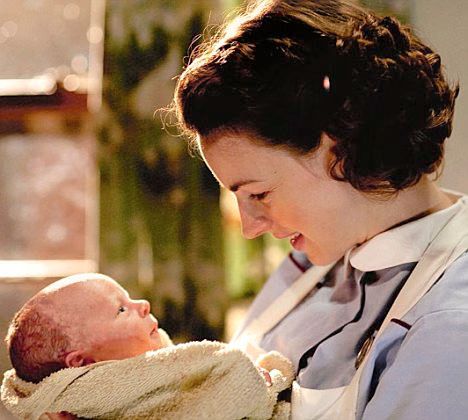
Jenny is placed on the district nursing roster for several weeks in order to develop her experience in community practice, and her first patient, Mr. Joe Collett (Roy Hudd), is an aging war veteran with leg ulcers from bullet wounds received in service. He lives in a run-down tenement building of questionable structural integrity, and Jenny must visit him three times a week to clean his ulcers and change the dressings on his legs. Over time, Jenny develops a friendship with the veteran, who's just about the sweetest old man you'll ever meet. He's lived in the apartment for as long as he can remember, living with his dear wife and raising his darling children. But then the London Blitz happened in 1940, and he suddenly found himself alone. He's surprisingly not bitter about it, even though his heart clearly aches for his lost family. It's weird, in that he doesn't seem to really be bitter about anything, taking everything in stride. This episode is very much about taking life in stride, as "Maybe a Baby" has two such men populating the narrative. It probably shouldn't be as effective a depiction as it ultimately is, yet Mr. Collett never fails to endear with his warmth and kindness.
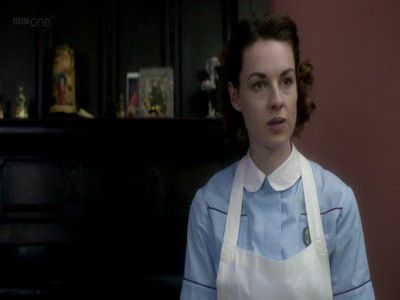
Less endearing, surprisingly, is Jenny, who, while visiting Joe to share a talk and a drink, recoils in disgust upon lifting a dish of biscuits and finding a couple of insects underneath. (Okay, more than a couple, but still...) She makes up some pretext to leave, and then retreats back to Nonnatus House, complaining about the squalid conditions and vowing never to go back. Sister Julienne quickly puts an end to all that, essentially telling Jenny that she needs to get the hell over it and quit being such a primadonna. It's peculiar that we're seeing this side to Jenny when we've seen her developing along more temperate lines. That said, I guess bugs are just her trigger, like snakes for Indiana Jones, as she twitches in her sleep, scratching at invisible insects.
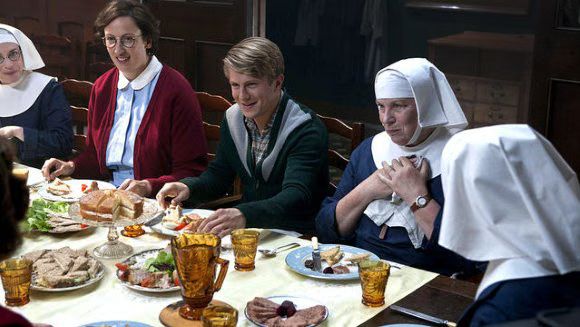
This doesn't last terribly long, however, as she's woken up by pebbles at her window. She opens to find Jimmy (George Rainsford), one of her oldest friends, and possibly the young man to whom she was referring in the premiere as the one that got away. Jimmy is rudderless, with nowhere to stay, and so Jenny (who once let him sleep for three months in the basement of her nursing school) allows him to stay in the boiler room for the night. But one night becomes two, two becomes three, and suddenly, Jimmy is ducking in and out at all hours. Ultimately, Sister Julienne (Jenny Agutter) meets Jimmy (under the pretenses of visiting Jenny), and invites him to dinner. The girls are quite taken with him, with Sister Monica Joan (Judy Parfitt), she of the escalating dementia, questioning when they're to be married. Jimmy, more or less oblivious, winds up insulting Jenny by implying that she's a strict, duty-minded woman who's a hair's breadth away from joining the sisterhood outright. Glad to see that guys were as tactless in the late 1950s as they are today. Makes me feel better about my relative lack of finesse.
The remarks about Jenny's commitment to her career cut deep, as it's more than just a career for her. She's come to truly care about Joe, offering to take him to an annual reunion of his military regiment, a gala he's missed every year due to his condition. It really is touching to see the look in his eyes when he's toasted by his regiment, or to see him so overcome with emotion upon the idea that two young people like Jenny and Jimmy would look out for him to such a degree (for his part, Joe sees Jimmy's attraction to Jenny, even if she seems hesitant to acknowledge it herself). It's the final night of object happiness before things start taking a turn for the worse, from Joe's tenement building being shut down, to an unfortunate complication in his condition. All the while, the friendship between Joe and Jenny stands not only as the episode's emotional center, but also as a fitting illustration of Jenny's development not only as a woman dedicated to her duty, but also to the goal of changing lives. It would be easy to let cynicism take over where Joe is concerned, yet he's such a warm presence that it's hard not to succumb to the emotional machinations of the plot.
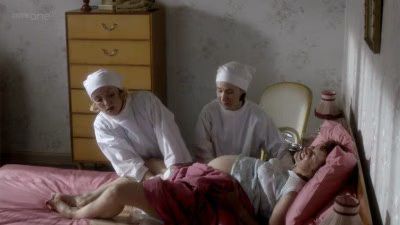
Much like Joe, Ted Lawson (John Ashton) is a man who doesn't let things get to him. He's got too much love in him to do otherwise. His wife, a shopkeep with three children from a previous marriage, is pregnant with Ted's first child. However, Winnie is in her forties, and she doesn't seem the least bit thrilled about the pregnancy, which makes Trixie (Helen George) suspicious. Though Jenny's story takes the bulk of the episode, Trixie's story is the most compelling plot in "Maybe a Baby." Winnie reveals that she married Ted in order to provide for her three children, but it's implied that she's grown to genuinely love the sweet-natured man over time, which is why it's all the more confounding that her pregnancy is such a source of concern and dread. As she goes into labor, the revelation comes out in one pained, expository scream, and it comes as a genuine shock. Worse yet is the judgmental look from the doctor on the scene, which tells the viewer all they need to know about the lot of women in less progressive days. Yet the story finds its tearful resolution through Ted's enduring strength of character. This is a real man, and again, it would be easy to allow cynicism to take root and laugh at the implausibility of how he acts. But it's beautiful if you allow it to be. It's these kinds of emotional arcs on the joy and cycle of life that really resonate on the show, and it's what Call the Midwife does best, from a first-time father holding his newborn son, to two lifelong friends sharing a glass of sherry in memory of a beloved friend.
Call the Midwife is getting more sure-footed in its characterizations, and that should be fascinating for the show, moving forward. If, for some reason, the show stumbles, in that respect, then at least there are the medical cases each week, that show the strength of these women, and the breadth of human resolve.