Call the Midwife - Series 1 Episode 2 - Video Recap and Review - The Browne Incident
I had been enjoying this week's Call the Midwife as the alternately light yet serious, contemplative show it appeared to be from the onset, and most of "The Browne Incident" does nothing to disabuse the audience of that notion. Yet there's a sequence that towards the end of the episode that I don't think I could ever watch again. Hardly anything is shown, but it's as tense as I've ever been while watching any TV show or movie. There's just something about the ceaseless ways a childbirth could go wrong that had me holding my breath during this week's climactic delivery. I suspect part of it is that, as a male, I'll never understand what it's like to give birth to a child, much less in the way that a child is delivered at the end of "The Browne Incident." But it goes further, since the episode does such a good job in establishing the risks, and the odds of something going hideously awry. By the end of the episode, male viewers could likely go from respecting what women do in bringing life into the world, to being downright awed by it.
Credit: BBC/Neal Street Productions
"The Browne Incident," of course, refers to the arrival of Camilla Fortescue-Cholmondeley-Browne (Miranda Hart) to Nonnatus House. Going by the name Chummy, Ms. Fortescue-Cholmondeley-Browne is something of a giant, with her big hands, lanky legs, and awkward gait, all of which draw ridicule from the children in town, particularly from a young boy named Jack. The largest outfit in Nonnatus House hardly comes close to fitting her, and her size makes it difficult for her to ride a bike (hence, she never learned how). While Chummy has a lot of experience as a nurse, she only barely qualified as a midwife, and so she must endure the constant, doubtful scorn of Sister Evangelina (Pam Ferris), who doesn't believe she belongs in Nonnatus House, particularly after she learns that Chummy has been late to many of her patient visits since she's walking instead of riding. It's a dynamic that's similar to Sister Evangelina's mentoring relationship with Jenny Lee (Jessica Raine) last week, except without the mentor's trust and faith in her charge's ability to do the work. In fact, Sister Evangelina gets downright cruel at times, deriding Chummy behind her back for her clumsiness and her seeming lack of aptitude for the profession. Writer and showrunner Heidi Thomas does a tremendous job in establishing Chummy as a sympathetic character right away, though it's to her credit that she also makes Chummy as likable as she is, to say nothing of just how competent Chummy turns out to be.
Credit: BBC/Neal Street Productions
Chummy's first delivery involves little Jack's 42 year-old mother, who is on her fifth child. The woman goes into labor during a family wedding, and the onus is now upon Chummy to master her nerves and make the delivery, flying solo. Making matters worse, Chummy discovers that the child is to be born in the "breach" position (i.e., arse-first), a delivery that would be difficult for even the most hardened of midwives, much less someone who's on their first delivery. This leads to Chummy taking a chance on a dicey, experimental delivery procedure for freeing the head from the birth canal, a procedure which Sister Evangelina believes to be straight-up lunacy. It's teeth-clenching television, to say the least, but it shows exactly the kind of brass tacks narrative the show is putting forth. Call the Midwife takes no measure to buff out the unpleasant particulars, getting ride down to the bare-bones biology of the matter, and it makes for a starkly beautiful hour. The strength of these women, on either end of the delivery, never fails to resonate. The show is as much about womanhood itself as about motherhood, and there's labor in both livelihoods. It's why the show is so compelling. It doesn't shy away from the poverty of the patients, the fear and inexperience of the new midwives, or the grizzled determination of the veterans. It just plain works, even when the show descends into melodrama, as it does with our protagonist, Jenny Lee.
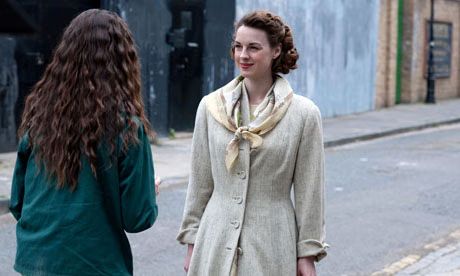
Jenny Lee, on the way home from yet another outing by herself, meets a young Irish girl named Mary. A tragic figure in more ways than one, Mary fled from an abusive home life in Ireland to come to London and find a better life. She eventually met and was taken in by a man named Zakir, who seduced her and put her to work in his brothel. Though Jenny insists that Mary confront the ugly nature of what Zakir did to her, she refuses to see it as anything but beautiful. Even though she's pregnant with the baby of any one of three different johns, she still looks on Zakir with love. It still doesn't stop her, however, from fleeing the brothel, where she meets Jenny and asks if she can convert a bank note on her behalf, so that she might have enough money to eat, in another instance that illustrates the breadth and depth of poverty in East London at the time.
Jenny, along with the help of a sympathetic clergyman, spirits Mary away to a home where she'll be safe. Mary gives birth to a daughter, named Kathleen, but as we soon learn, the happiness isn't to last. The child is taken from her and put up for adoption since, as we discover, Mary is only 15, thus a child herself. As the clergyman explains, the decision was a matter of which child to protect, and so they chose to protect the baby by taking it from its "child" mother. The pain of loss communicated in the plot is resonant and also illustrates Jenny's growth, as she stops just short of cursing out the clergyman for what he's done, and then comforting Mary by wrapping her absessed breasts with her own Parisian scarf, which Mary had admired upon their first meeting. It's a heartbreaking storyline that speaks to a larger issue of cycles: the cycle of motherhood, of life and death, and of love and loss. More starkly, it speaks to Zakir's cycle of seducing young girls and then employing them in his brothel, which we're told is one of the oldest tricks in a pimp's handbook. Putting an end to such cycles is a lot harder than just spiriting the girls out of town. There's despair in the continuation of the profession, the oldest in all the world. As Future Jenny explains that Mary never sees her child again, it's all too miserable a reminder of what is gained and lost through abuse. That sometimes, beautiful things can flower out of the grimiest dirt, yet still be plucked away just the same.
Call the Midwife remains one of the most pleasant surprises of the fall season this year. I find myself loving the characters in this ensemble, from kindhearted Sister Julienne (Jenny Agutter) to lovable handyman Fred (Cliff Parisi). It's a uniformly strong cast, and Miranda Hart should make for an excellent addition. Also, Jessica Raine is developing all the qualities of a strong leading lady, and I'm very much looking forward to seeing that progression as the series moves forward. As it stands right now, "The Browne Incident" is every bit as good as last week's premiere, and I only see the show getting better as we become more comfortable in its world.
Watch Behind the Scenes - Riding Bikes on PBS. See more from Call the Midwife.