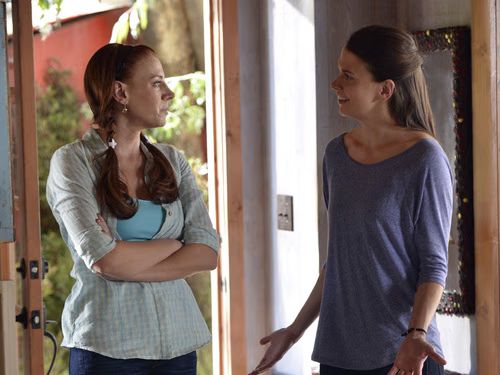
Bunheads - Season 1 Episode 4 - Recap and Review - Better Luck Next Year
Bunheads continues to be the free-wheeling series this summer desperately needs amidst the lusty, soap operatic fun of True Blood, the weighty political heft of The Newsroom, and the “It's about to go DOWN, you guys” badassery of Breaking Bad (seriously, Sunday can't come soon enough). When we left off two weeks ago, Michelle (Sutton Foster) moved into the guest house, allowing Fanny (Kelly Bishop) to keep her home and all its eccentric furnishings. While it would appear to be out of kindness, not wanting to uproot Hubbell's dear mother from the only home she's known, this episode makes it apparent that Michelle likely moved in order to put some distance between herself and Fanny, who shows a bit of motherly doting in between bouts of adversarial nagging.
Fanny, in her usual fit of fastidiousness, is micromanaging the auditions for Joffrey Ballet's summer dance program, which are scheduled to be held in Paradise, a victory that means way more to Fanny than it probably should. Entered into the micromanagement fray is Truly, who not only assists Fanny in making preparations for the auditions, but also helps Michelle remodel the guest house, which has recently been loaded with inherited, unwanted bric-a-brac. This latter development is a bit of a surprise, given the enmity Truly has shown for the woman who would become the widow to Hubbell, the love of Truly's life. It's a brief, but strong scene, as the two bond over house repairs, the handsomeness of Jason Priestley and, in particular, the personal history of Fanny. She's apparently been dancing since age four, was on point by age nine, won her first dance competition by age ten, and was offered the opportunity to dance overseas by age sixteen. Her dance career, however, was cut short when she fell in love, gave birth to Hubbell, and moved to Paradise, opening the dance studio in lieu of continuing her high-visibility dance career.
When Fanny learns that the Joffrey Ballet has canceled its auditions in Paradise and moved them thirty miles to the town of Ojai, California, she's understandably crushed. The way the operators of the Joffrey Ballet are spoken of evoke Michelle's own flat-out rejection in the pilot. In the pilot, Michelle was shooed off the stage by a show director without even being given the opportunity to perform, in much the same way the Joffrey Ballet does not seem terribly concerned with giving Paradise a chance, citing its warped wood floors, in desperate need of repair. Cue Michelle going on a crusade to fix those floors by any means possible.
The episode portrays the nebulous Joffrey Ballet program as both prestigious and fronted by a squadron of self-righteous snobs who traffic in girls' tears. Might as well have called it the Joffrey Baratheon School of Dancing, Beheading, and General Treachery. Yet, the auditions are about more than just the people holding them. For Michelle, it's a chance to have her redemption after the embarrassing rejection in the pilot by the uptight director (about whom she has a pair of nightmares this week, realized as terrific dream sequences in which Sutton Foster shows off the skills that made her a Tony winner in the first place, performing “Me and My Baby” from the original Broadway production of Chicago). For Fanny, this is her chance to reclaim a portion of the career she sacrificed for her family. For Boo, who's been frequently rejected by the Joffrey Ballet, it's a desperate grasp at affirmation as a dancer. Lastly, the auditions present an opportunity for Sasha to bond with Boo, towards whom she lashed out in our most recent episode two weeks ago. It was apparent, at the time, that Sasha was simply directing her anger towards her mother at Boo. This week, the dynamic is reversed, as Boo lashes out at Sasha, furious at her own mother's apparent lack of faith in her talents.
Boo is, far and away, the show's most sympathetic character, and her problems are not at all exaggerated to fit into the televised medium. They're relatable conflicts, representative of what many teens, not simply girls, have endured everywhere. We're given to presume that Boo has had weight issues in the past, or at least the fear of being perceived as overweight, and we see Boo going to great lengths to maintain her figure, under the auspices of preparing for the Joffrey Ballet auditions. Kaitlyn Jenkins is a beautiful girl that no person with two eyes and a brain behind them could call fat, yet there's a body language to her performance as Boo, from the shy, guarded nature of how she presents herself, to the straight-backed posture she adopts to appear thinner. We can see that these are issues inherited from her mother, who worries about her own health, while trying to make a dietary justification for eating kettle corn at the local farmer's market. In this scene, we're told that, after Boo was not accepted into the Joffrey Ballet program last summer, the two of them ate an entire layer cake by themselves. Perhaps it was the moment Boo started to go out of her way to break the habits engendered by her mother, as she makes a point of saying that she's in better shape this year than last, to which her mother insists that she's always been in shape. Of course, that doesn't stop Boo's mother from preemptively purchasing a “Better Luck Next Year!” layer cake, with the presumption that they'll be indulging themselves again before it's all said and done. Boo, for her part, resists the temptation to give up hope for her audition and eat the cake, instead opting to snack on broccoli. Unfortunately, Boo gets cut anyway, even though the auditions are moved back to Paradise (so much for the home-field advantage). Worse, she's cut two more times, under disguises fashioned by Fanny. However, even though she's been cut yet again, it's clear that Boo now has a degree of confidence in her appearance and in her skills as a dancer that she didn't have before. And Sasha, who stole money from her mother to secretly buy Boo a new pair of ballet slippers for the audition, is closer with Boo, who invites her over for some cake. The “Better Luck Next Year!” dessert is going to be split amongst three this time.
The messages of determination and confidence continue, and the show maintains its rapid-fire wit, the trademark of any Amy Sherman-Palladino show. This week did a particularly good job of spreading the wealth amongst the ensemble, with even Truly, and the little-seen bar proprietors Rico and Nina, getting their due. It's a strong cast, even for a show as light as this one. Yet the show's lightness doesn't mean it lacks substance.