Breaking Bad - Season 5 Episode 8 - 2012 Finale - Video Recap and Review - Gliding Over All
Here is the recap and review of Breaking Bad Season 5 Episode 8: "Gliding Over All."
* * *
"Gliding Over All," the 2012 finale of Breaking Bad, is a taut, thrilling examination of Walt's fevered efforts to clean up his many messes. At a deeper level, however, it's a retrospective on the events that brought Walt to this point, and whether the ends still justify the means. The title of the episode comes from a Walt Whitman poem, collected in "Leaves of Grass," the book Hank discovers in Walt's house, with an inscription from the late Gale Boetticher, which finally keys him into the truth about his brother-in-law, after five long seasons of frustrated ignorance:
Gliding o'er all, through all,
Through Nature, Time, and Space,
As a ship on the waters advancing,
The voyage of the soul—not life alone,
Death, many deaths I'll sing.
In many ways, Breaking Bad is the voyage of Walt's soul, of a life grown increasingly isolated, singing of many deaths. This is to say nothing of the extent to which Walt's criminal empire seems to be advancing along on the waters, despite the fact that it's essentially back to being a two-man operation, with an outside distributor. Walt has no one on whom to reliably depend other than Todd, the poor man's Jesse Pinkman, and desperate, paranoid Lydia.
Credit: AMC
Following up on last week's climactic shooting, Walt (Bryan Cranston) calls Todd (Jesse Plemons) to help him dispose of Mike's corpse, reiterating to the audience that, sooner or later, there comes a barrel for everyone. Strangely, Walt seems to gain no satisfaction at the prospect of dissolving Mike's body in acid, and it's hard to say whether having killed Mike will do anything for his ego, as there is evidence both for and against in this episode. In the "for" column, we have Walt meeting with Todd's criminally-connected uncle to help devise a hit on Mike's "guys," each of whom are in prison, and each of whom are likely to talk, now that Mike isn't around to pay them their hush money (the "legacy tax"). Walt's brazen plan, which involves spreading the killings across the three separate prisons in which each man is being held, confounds his accomplices, who insist that such a series of hits would be practically impossible to achieve. This leads to a telling exchange:
"It can't be done how you want it."
"It can be done exactly how I want it. The question is, are you the man to do it? Figure it out. It's what I'm paying you for."
Better than most moments this episode, this conversation illustrates Walt's escalating boldness in the wake of Mike's murder. There have been many milestones in Walt's criminal career that have erased the notion from his head that there is anything that is truly "impossible." All things are possible for Walt after killing Gus Fring and manipulating Jesse out of believing he poisoned Brock; not to mention the various capers of increasing difficulty he's pulled off this season, from the magnet plan to the train heist. Walt has gotten so good at accomplishing the improbable that he feels there are no limits anymore. And if the men he's paying don't feel the same way, he'll just pay someone else who does. Because what's the point of money if not to get what you want?
The prison killings are drawn out over a classic Breaking Bad crime montage, with the incongruous music choices that transforms the action onscreen from a horrific tableaux of unfeeling violence to a macabre interpretation of criminal necessity. Walt needs these men dead, and who cares how it's done? As long as it gets done. And it does get done. Set to the Jerome Kern classic, "Pick Yourself Up," we see criminals getting shanked, locked in doorways with pick-wielding inmates, guys offed in the shower, and one guy getting doused with flammable fluids, locked in his cell, and then set aflame. No half-measures for Walt. He learned that from the best.
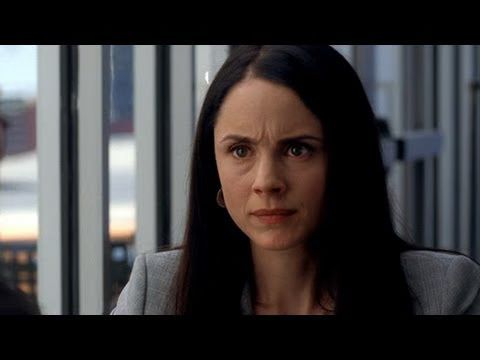
Also pumping up his ego, following Mike's death, are Walt's dealings with Lydia (Laura Fraser), who's convinced Walt means to kill her. So she argues for her life, saying that she can utilized Madrigal to serve as the distribution front for Walt's product - moreover, the product can be distributed internationally, to the Czech Republic, where the purity has never been above 60%. Walt's 99.1% purity would blow this country's mind. Yet Walt still isn't sold until Lydia claims she made the same deal with Gus Fring before his death, and that they were in the final stages of launching the enterprise. Seeing an opportunity to finally embark upon a business venture which Gus Fring never could, Walt shakes on the deal...and pockets the capsule of ricin he'd planned to poison her with.
But perhaps the biggest indicator of Walt's boldness during the Mike fallout is in how he treats Jesse (Aaron Paul). After assuring him that Mike is gone, which Jesse takes to mean as Walt confirming delivered Mike his duffel bag of money and his gun so he could skip town, Walt tells Jesse that "there is no 'we'," when Jesse asks what they're going to do next. Walt needs Jesse more than he knows, but he isn't willing to give Jesse the satisfaction after he was so adamant about leaving. Later, at his house, Jesse insists to Walt, after they wax nostalgic about their old, beat-up RV, that he's still out. Jesse asks why they kept the crummy RV when they had more than enough money to get something more reliable, and Walt replies, "Inertia." The resistance to change, in spite of its necessity. This idea is further illustrated when Walt tells Jesse that he brought something for him. As Walt leaves and Jesse steps out on the front porch, he sees Walt's offering: Mike's duffel bag of money, with his gun. Jesse locks himself in his house and breaks down, realizing that Mike, a better friend and mentor to him than Walt had ever been, never got away and is more than likely dead. Just how much Jesse knows, or can infer, of what happened is unclear, but Walt's message to Jesse seems relatively straightforward, a warning: This is what happens to people who try to leave. Walt claims to have gotten rid of the RV out of inertia, which makes sense, since he seems more resistant to change than anybody. (Strange that he forgets to mention the necessity behind why they really got rid of the RV, as a means of destroying evidence)
Now, as for marks in the "against" column, the events that illustrate that perhaps killing Mike has made Walt reconsider the business he's in, there aren't nearly as many examples, yet there remain nuggets of information spread out among the bigger moments of the episode. First and foremost is the second in our pair of excellent Breaking Bad crime montages this episode, which demonstrates Walt's system of operation, from cooking the meth to packaging, and then distribution on Lydia's end, and finally, the laundering portion on Skyler's end. It's all
set to 1969's "Crystal Blue Persuasion" by Tommy James and the Shondelles, a music cue so obvious and genius I'm gobsmacked they've never used it before tonight. As the montage closes, we're given an overhead view of Albuquerque, with each of Walt's meth-cooking bases signified by a bug-bombing tent, as if each house were a playing piece in a giant game of Monopoly. And really, isn't that what this is, for Walt? Yet, once the montage ends and we're suddenly watching little Holly as she learns how to walk (a parallel to Walt finally finding his feet in the "empire business"), we come to realize just what Walt is losing.
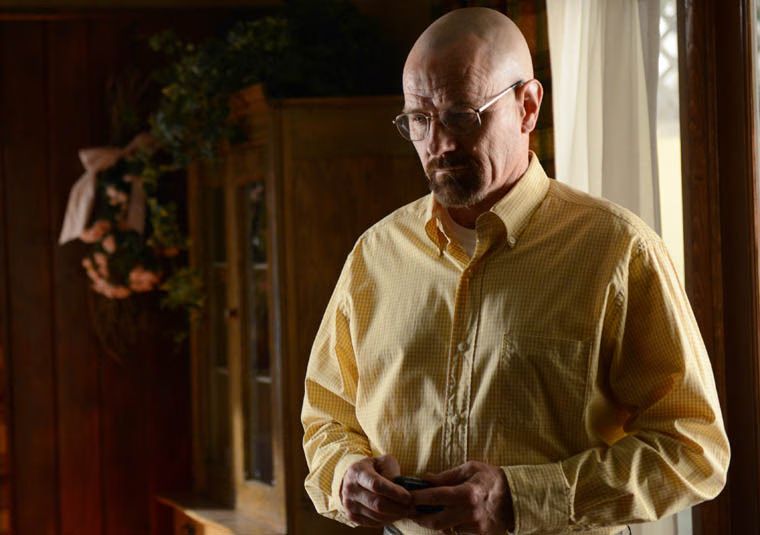
Yes, he still sees his children, and Skyler actually seems relatively upbeat for once, but this isn't a family anymore. It's a loose confederation of independent individuals, held together by connections that seem increasingly arbitrary as time goes by, since Walter is hardly recognizable as Holly or Walt Jr.'s father these days, even though he'll always hold the title biologically. And what Walt and Skyler have can't even be called a "marriage" in any respectable sense anymore. It's more-or-less a hostage situation. So it rings false, later on, when Walt seems open to the idea of quitting the business, despite our knowledge of how much killing Mike has shaken him. Skyler, for her part, gives it the old college try, as she brings Walt to a storage shed she's rented and reveals to him a pile of money that would shame Scrooge McDuck. She has no idea how much money there is, but it's much more than the roughly $700,000 Walt initially claimed he needed to make in order to consider quitting. It's in all sorts of different denominations, and Skyler doesn't know how they could ever launder it, much less spend it. They're set for life, and it's imperative that Walt sees it, and understands it. Skyler has always been suspicious of Walt's motives for cooking meth, not really buying that he's doing it solely for the family. If she can bring him face-to-face with this kind of money, and he still feels tempted to keep cooking, then she'll know he's not doing it for them at all.
"How big does this pile have to be?" Skyler asks, and it's reminiscent of Jesse's plea with Walt, asking how many more people have to die because of them. Whether it's money or bodies, it's always one pile or another with Walter White, and one pile always inevitably feeds into the other, since the money could never have accrued to the point it did if it weren't stacked on the bodies of Gus Fring, Mike Ehrmantraut, even people like Combo and Jane. In some cases, the deaths were an unfortunate complication, as in the death of the dirt bike kid, while other times, the deaths were a necessity of trade in the "empire business." Mike's murder has noticeably changed Walt in some way, made him more meditative on the nature of what he's doing. It helps that his ego was a bit more reigned in, despite his bigger power plays - but in sparing Lydia, for instance, we see a less impulsive Walt, a man more likely to listen to reason, whereas he'd never listened while Mike still lived. That said, one episode's worth of restraint will hardly undo all the reckless abandon of a man drunk on his own hubris. It remains to be seen whether Walt has actually learned anything from all that's happened in the past several weeks.
So is Walt telling Skyler the truth, towards the end of the episode, when he seems to have a sudden revelation and assumes a stoic posture, claiming that he's out, once and for all? He's tied up all his loose ends, and has made more money than he could spend "in ten lifetimes," as Skyler claims. So is he truly out? Or is it just another lie?
Whether or not he's out, ultimately, his choices will come back to haunt him, as they do in the mind-blowing stinger. As Hank, Marie, Walt, Skylar and the kids spend a quiet, sunny afternoon by the pool at the White residence, everything is peaceful in a way it hasn't been in ages. That is, until Hank excuses himself to go to the bathroom. As he rifles through the Whites' reading materials on the john, he comes across a copy of "Leaves of Grass"...with an inscription from Gale Boetticher. As Hank is sitting on the toilet, he has a very literal "Oh s***" moment: Walt IS Heisenberg.
Fade to black.
One of the big questions of Breaking Bad, over five seasons, has been whether Hank would ever find out that Walt was the meth cook he's been hunting for the past year and a half, the elusive Heisenberg? Now, we have our answer, and we have our pieces in place for next year's endgame. Jesse and Walt are at odds, while Walt himself might well be out of the business altogether; meanwhile, Hank has finally put it all together. The second half of Breaking Bad's final season, airing in 2013, should prove to be as explosive and combustible as the elements of Heisenberg's product, and no less corrosive on the characters looking to come out alive on the other end.
http://c.brightcove.com/services/viewer/federated_f9?isVid=1
Latest News on Breaking Bad
All News on Breaking Bad