The Academy Announces Even More Oscar Rule Changes - Report
After announcing yesterday that it has changed the rules to avoid any future Oscar disqualifications like we had this year, The Academy of Motion Picture Arts and Sciences has added several new changes to the official rules. And these changes affect damn near every category.
First and foremost, the Academy has lifted the limit on how many producers can be credited for a Best Picture nomination. For many years now, the amount of producers eligible to be nominated under the Best Picture statute has been three. This was to stamp down on the obscene number of people who could conceivably be credited as a producer, and thus win an Oscar statuette in the bargain (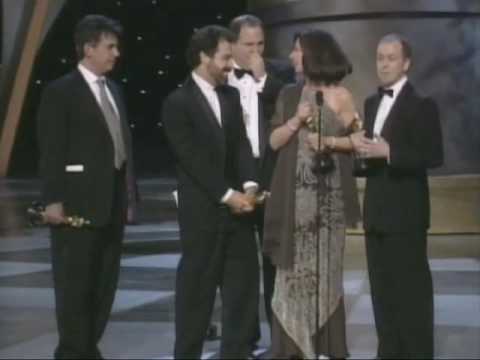 for the rule change).
Credit: ABC / AMPAS
At an unofficial capacity, the limit had already been lifted, since this year's Best Picture winner, 12 Years A Slave, featured five producers taking home Oscars (including Brad Pitt, who can now be billed as "Academy Award winner Brad Pitt" at long last). Technically, there's still a limit to three producers, but the Academy is getting around this rule (without changing it) by counting producing pairs who have been working together for at least five years, and who've made at least two previous films. In essence, if a producing pair meets these qualifications, they'll be counted as a single producer. However, the catch here is that the executive committee of the Academy can still add any additional qualified producers to the ballot, as they see fit.
But the changes aren't limited to Best Picture. The acting categories are getting some new rules as well.
Credit: Warner Bros.
The official "reminder list" sent to Oscar voters every year -- reminding them of which actors played which role in a given picture -- will now be limited to 10 actors and 10 actress per picture. These lists, as well as the For Your Consideration ads taken out in trade papers, screeners, and online publications, can offer suggestions as to which category an actor should be placed when voting, yet the ultimate decision remains with Academy voters. For example, Ethan Hawke really should have been considered for Best Actor for his role in Training Day, since he was technically the lead character. Yet the Academy nominated him as Best Supporting Actor, possibly because Denzel Washington was the bigger star with the showier role. It's category fraud, but according to these rules, the Academy will continue to be well within its rights to make such decisions, even if other awards-giving bodies see things differently. (I mean, yeah, it's great that Casey Affleck has been nominated for an Oscar, but in no way, shape, or form was he a supporting actor in The Assassination of Jesse James by the Coward Robert Ford).
Credit: Disney
Meanwhile, the Best Animated Feature category has new submission guidelines, primarily that DVD screeners are now required. These will replace the official Academy screenings that committee members from the animation branch had to attend in order to vote. As for documentaries, the Best Documentary Feature category now requires that a documentary feature must play in both Los Angeles and New York in the same year in order to qualify. In addition, it must screen at least four times per day, with at least one of those showings beginning between the hours of 6:00 PM and 10:00 PM, presumably to accommodate the schedules of the widest number of potential voters. Also, advertising for the documentary must run in at least one major newspaper, and must be reviewed by either the Los Angeles Times or the New York Times.
Credit: ABC
But the most interesting development comes in the Best Original Song category: musical groups can now submit songs under the group name, rather than as individuals. However, if they do so and end up winning, they will only receive one Oscar to share between them. So why would any group decide to submit as a group instead of as individuals? The reason is that the Academy prohibits any more than two statuettes to be handed out in the category. However, the rules dictate that a "third statuette may be awarded when there are three essentially equal writers of a song. The Music Branch Executive Committee has the right, in what it alone determines to be a very rare and extraordinary circumstance, to award a fourth statuette." So it wouldn't be impossible, per se, for U2 to submit as individuals, win, and then receive an Oscar for each member. But it's on a case-by-case basis.
As for Best Production Design, formerly the Best Art Direction award, the new rules stipulate that the contributions of the chief digital designer can now be nominated for his or her contributions alongside the production designer and set decorator. Lastly, for the short film categories -- Best Animated Short, Best Documentary Short, and Best Live Action Short -- there are now two more ways to become eligible for a nomination: a film can either win one of the listed film festivals approved by the Academy, or a film can win a medal at the Student Academy Awards.
Ultimately, while these rules might seem excessive, they make for a tighter Oscar voting process. The process -- particularly that of Best Original Song -- has been compromised for the better part of the past decade due to archaic voting processes and inert ways of thinking about how music in a film should be considered. I could still do without the open endorsement of category fraud in the acting categories, but that's just a trademark of the Academy (Barry Fitzgerald was nominated for BOTH Best Actor and Best Supporting Actor FOR THE SAME ROLE in 1944's Best Picture, Going My Way. Naturally, a rule was instated afterwards that prohibited this from happening again). This is a necessary evolution of the Academy process, and they're certainly upping their profile by inviting several fresh faces to join the Academy, including Oscar winner Lupita Nyong'o and nominee Pharrell Williams. It should be interesting to see how these rule changes affect the outcome of the voting process in seven months' time.
H/T: Gold Derby